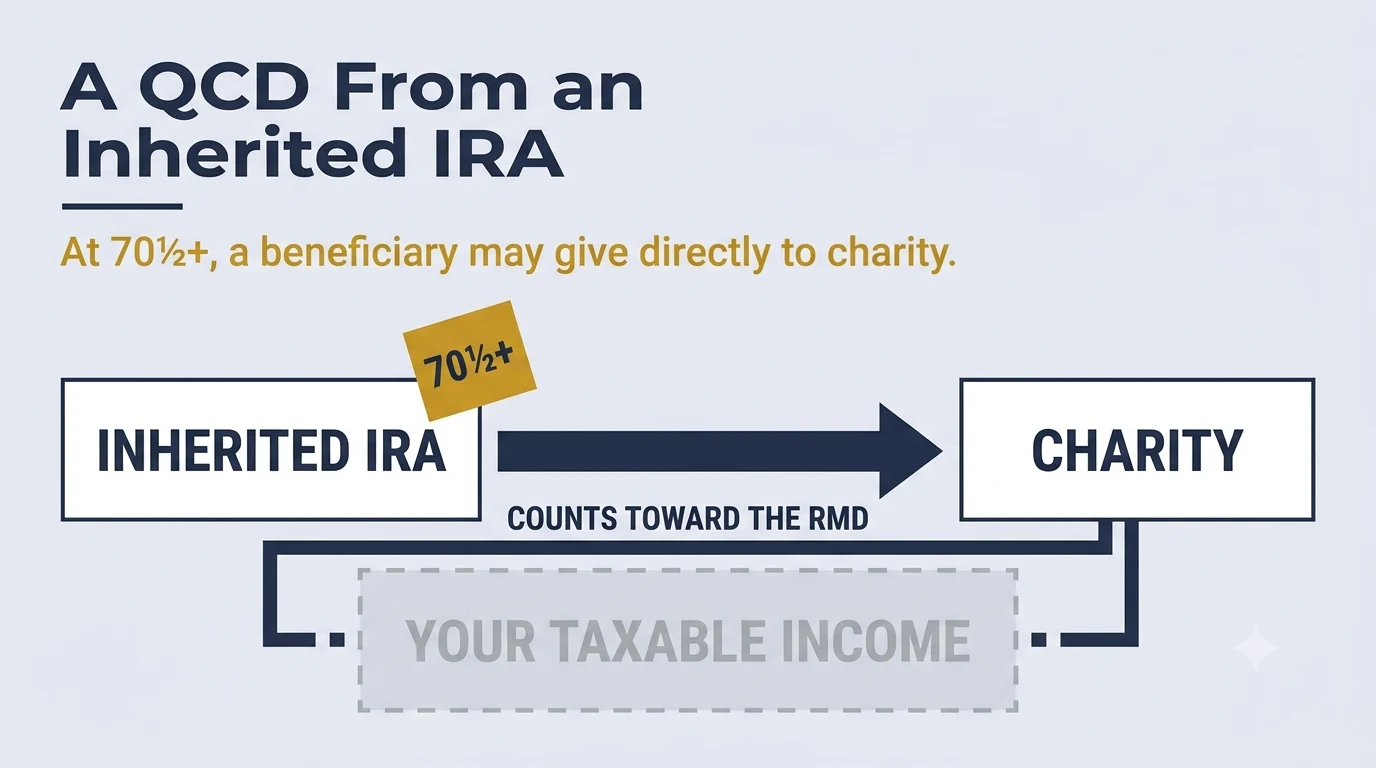
Inherited status does not automatically block a QCD
Publication 590-B explains that a beneficiary who has attained age 70½ can make a qualified charitable distribution from an inherited IRA, assuming the other QCD requirements are satisfied. The payment must be made directly by the IRA trustee to an eligible charitable organization.
The beneficiary’s age matters
The QCD age test applies to the individual making the QCD. A 68-year-old beneficiary does not qualify merely because the deceased owner was 80. Conversely, a beneficiary who has actually reached age 70½ may be able to use the QCD rules even though the account is inherited.
A QCD can count toward the inherited IRA’s RMD
Publication 590-B states that a QCD can satisfy all or part of an IRA RMD for the year. If an inherited IRA has a $12,000 annual RMD and the eligible beneficiary directs a $7,000 QCD first, that $7,000 can count toward the annual minimum, leaving $5,000 still to be satisfied, assuming no other distribution.
Ordering matters if regular distributions already occurred
RMD rules generally treat early distributions during the year as satisfying the minimum as they occur. A beneficiary planning a QCD should coordinate before taking the full RMD as cash, because a later charitable payment does not retroactively make an earlier taxable cash distribution disappear.
Direct payment to the charity is essential
A beneficiary should not withdraw money to a personal bank account and then write a personal charitable check while calling the IRA withdrawal a QCD. The QCD requires direct trustee-to-charity payment under the IRS rules.
Keep the charitable acknowledgment and IRA reporting
The IRA custodian reports the gross distribution on Form 1099-R; it generally does not determine on the form how much qualifies as a QCD. The beneficiary must substantiate the charitable payment and report it correctly on the return. Keep the custodian confirmation and the charity’s acknowledgment.
Annual dollar limits change
The QCD exclusion has an inflation-adjusted annual limit. Use the IRS amount for the actual tax year rather than copying a prior-year figure into a standing withdrawal instruction.
Only the taxable portion can be a QCD
A qualified charitable distribution is an exclusion from income, so it only helps to the extent the distribution would otherwise be taxable. For an inherited traditional IRA with no basis, the full amount is generally eligible. If the decedent had nondeductible basis in the IRA, a special QCD rule treats the charitable distribution as coming first from the amounts that would otherwise be taxable—the opposite of the usual pro-rata order—so the exclusion is not diluted by basis.
The QCD lifetime cap and the one-time larger election
The annual QCD exclusion is indexed for inflation, and there is also a separate one-time election to direct a larger amount to a split-interest entity such as a charitable gift annuity or charitable remainder trust. A beneficiary considering either should use the dollar figures published for the actual tax year and confirm the receiving vehicle qualifies, because the rules for split-interest QCDs are narrower than for an outright gift to a public charity.
Do not use a QCD as a substitute for beneficiary classification
A QCD is a tax-treatment rule for an eligible charitable distribution. It does not change whether the beneficiary is subject to annual RMDs, the 10-year rule, or a life-expectancy rule. Determine the inherited-IRA distribution regime first, then decide how a QCD fits within that year’s required and discretionary distributions.
The charity must be eligible to receive a QCD
Not every charitable-looking organization or giving vehicle qualifies. QCD rules exclude certain recipients, and the beneficiary should verify eligibility before instructing the custodian. Donor-advised funds and supporting organizations, for example, have special limitations under the statute. Use current IRS guidance for the tax year.
QCD reporting requires an explanation on the return
The custodian generally reports the full IRA distribution on Form 1099-R rather than issuing a special “tax-free QCD” amount in box 2a. The taxpayer reports the IRA distribution and identifies the qualified charitable portion according to the Form 1040 instructions. That makes the charity acknowledgment and custodian payment confirmation essential.
Traditional inherited IRA and Roth inherited IRA can produce different tax value
A QCD exclusion can be especially relevant when the distribution would otherwise be taxable. If an inherited Roth distribution is already nontaxable, the income-tax benefit can differ. The RMD-satisfaction function may still matter, but tax treatment should be modeled rather than assumed.
- Check the beneficiary's age and recipient eligibilityThe owner's age does not replace the beneficiary's age test.
- Ask the trustee to pay the charity directlyDo not route the gift through a personal bank account.
- Coordinate timing with other RMD distributionsA later gift does not undo an earlier cash distribution.
- Keep charity acknowledgment and custodian confirmationUse them to report the distribution correctly.