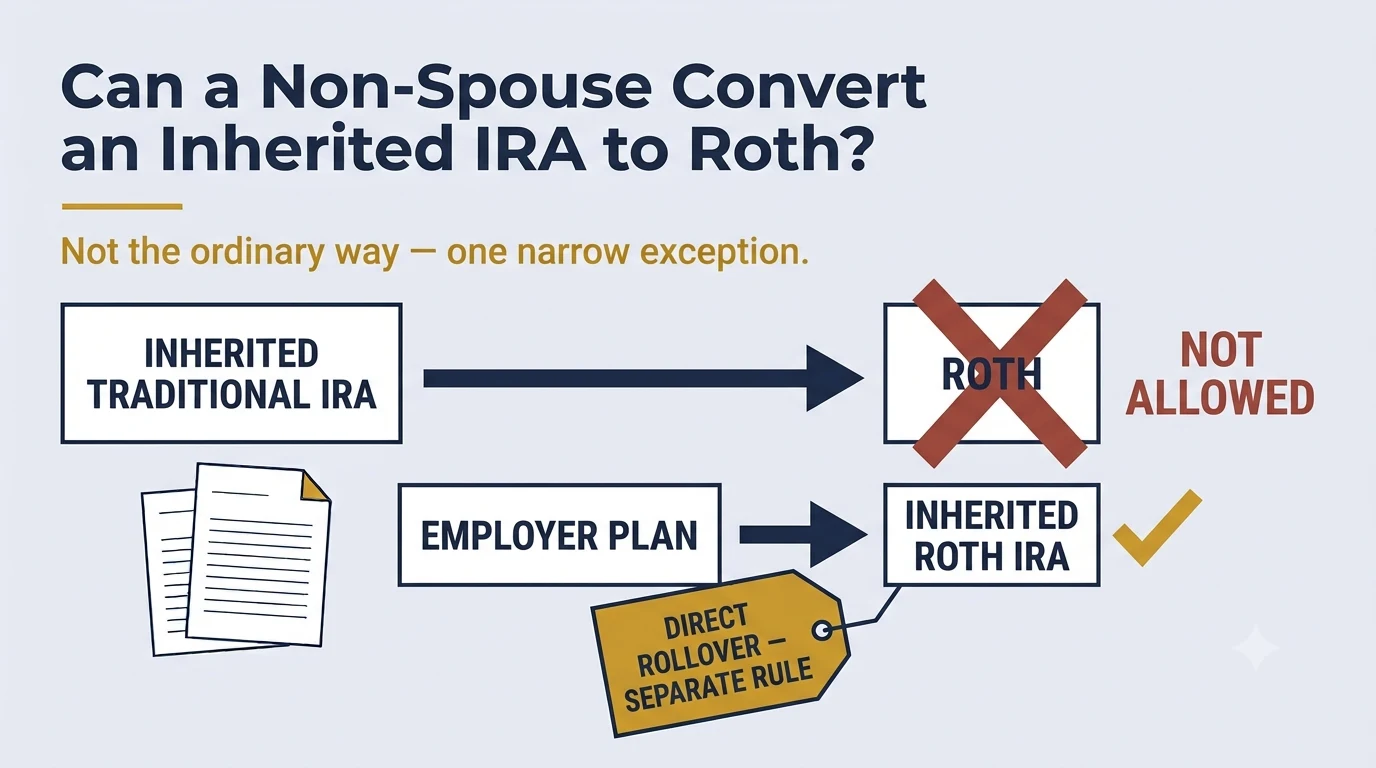
Start by separating two transactions that sound similar
A Roth conversion is treated as a rollover transaction. Publication 590-A says a non-spouse beneficiary generally cannot roll over amounts into or out of an inherited IRA. As a result, a non-spouse beneficiary generally cannot take an inherited traditional IRA and perform the ordinary conversion used by an owner moving personal traditional-IRA money into a Roth IRA.
That answer should not be confused with a separate rule for a non-spouse beneficiary receiving an eligible distribution from an employer retirement plan.
Inherited traditional IRA → inherited Roth IRA
For an IRA already inherited from a non-spouse, the normal Roth conversion mechanism is generally not available because the beneficiary cannot treat the inherited IRA as his or her own and cannot use the ordinary rollover route.
Employer plan → inherited Roth IRA can be different
Publication 575 permits a non-spouse designated beneficiary of an employer plan to make a direct trustee-to-trustee rollover to an inherited IRA. Depending on the source and transaction, an eligible plan amount may be directly rolled to an inherited Roth IRA, with taxable consequences for pre-tax amounts. The receiving account remains inherited; it does not become the beneficiary’s personal Roth IRA.
Example: two siblings, two account sources
| Source | Proposed move | Key rule |
|---|---|---|
| Inherited traditional IRA from parent | Convert to inherited Roth IRA | Ordinary non-spouse IRA rollover/conversion route generally unavailable |
| Parent’s pre-tax 401(k) paid by direct rollover | Directly roll eligible amount to inherited Roth IRA | Employer-plan non-spouse direct-rollover rules may permit it; taxable income can result |
RMD amounts themselves are not rollover-eligible
Even where a direct rollover from an employer plan is permitted, a required minimum distribution is not an eligible rollover distribution. The plan and receiving custodian should determine the current-year RMD before moving the remaining eligible balance.
Questions to ask before signing a conversion or rollover form
- Is the source already an inherited IRA, or is it still an employer plan?
- Will the transaction be trustee-to-trustee?
- Will the receiving account remain titled as inherited from the decedent?
- How much of the transfer is taxable pre-tax money?
- Has any current-year RMD been removed first?
These distinctions prevent a form labeled “Roth conversion” from being applied to an account for which the beneficiary does not have the legal owner’s rollover rights.
Why the rule is that a beneficiary cannot convert an inherited IRA
A Roth conversion is defined as a rollover from a traditional IRA to a Roth IRA. The tax code lets a spouse beneficiary who has elected to treat an inherited IRA as their own do this, because at that point it is the spouse's own IRA. A non-spouse beneficiary never gets that election, so the account never becomes a traditional IRA the beneficiary can roll over. The bar is structural, not a discretionary IRS position, which is why no custodian workflow can override it.
What the employer-plan route can and cannot achieve
The employer-plan direct-rollover route lets a non-spouse beneficiary land pre-tax plan money in an inherited Roth IRA and pay the tax now. It does not create annual Roth contribution room, and it does not let the beneficiary later move that inherited Roth into a personal Roth IRA. The receiving account stays an inherited Roth IRA with its own 10-year deadline. The only real decision is whether paying tax on the rollover now is worth the tax-free growth for the remaining inherited period.
A taxable withdrawal followed by a personal Roth contribution is not a conversion of the inherited IRA
A beneficiary might withdraw cash from an inherited traditional IRA and separately contribute to a personal Roth IRA if independently eligible under the normal contribution rules. Those are two separate transactions: a taxable beneficiary distribution and a personal Roth contribution. Calling the combination a “conversion” obscures contribution limits, income eligibility rules, and the fact that the inherited withdrawal cannot simply be rolled into the personal Roth.
Do not let software present every IRA with the same “Convert to Roth” button
Brokerage interfaces are often designed around ordinary IRA owners. If an inherited IRA screen offers a generic conversion workflow, confirm with the institution that the feature is legally available for that registration before proceeding. The existence of a button is not authority for a non-spouse rollover.
Employer-plan direct rollover needs source-by-source accounting
A plan can contain pre-tax money, designated Roth money, and after-tax amounts. If a non-spouse beneficiary is using the employer-plan direct-rollover route, the tax character of each source and the receiving inherited IRA type matter. Obtain the plan’s source breakdown instead of relying on the total account balance.
- Request a source-by-source breakdownA plan may contain pre-tax money, designated Roth money, and after-tax amounts.
- Match each source to an inherited account typeKeep the tax character of the assets clear.
- Identify and remove any current-year RMDAn RMD is not eligible rollover money.
- Confirm the receiving account and tax reportingUse the plan and custodian records for each source.