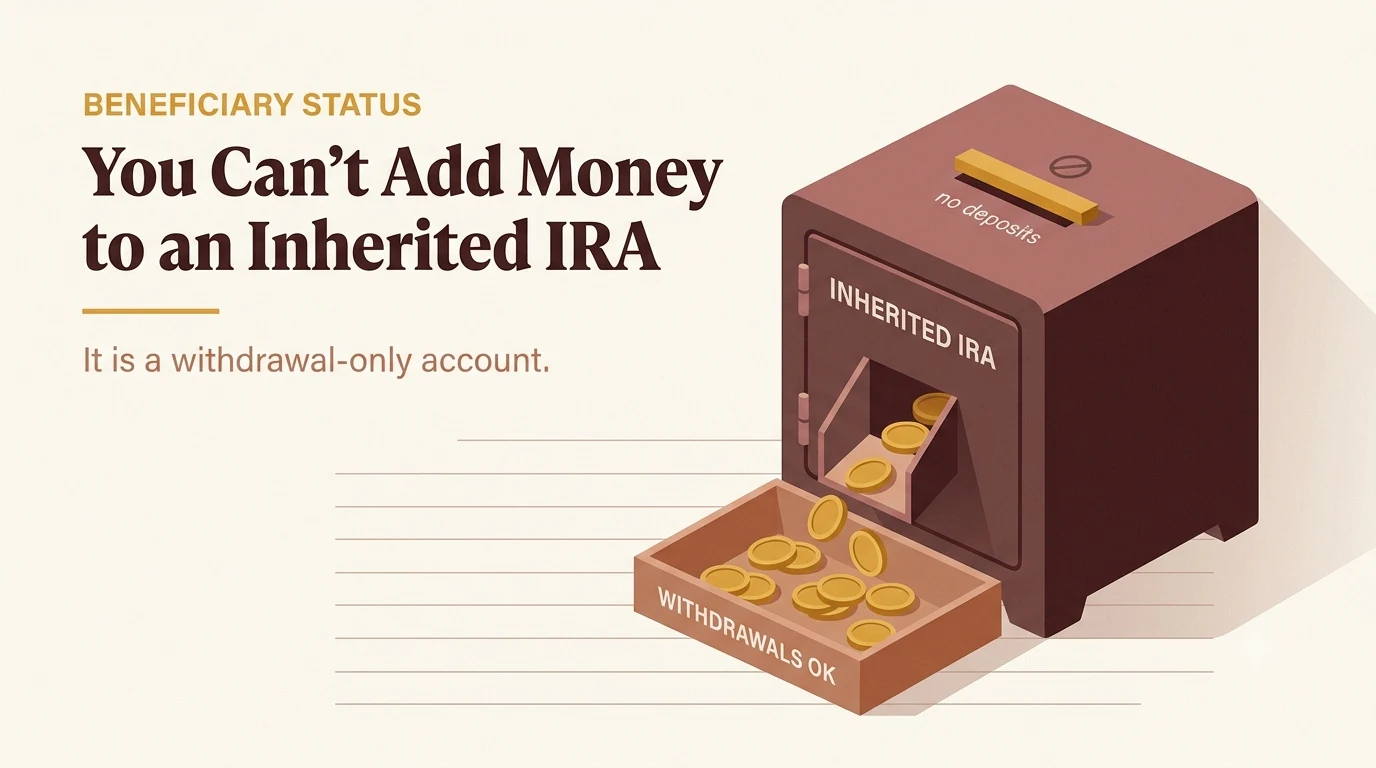
For a non-spouse beneficiary, the inherited IRA is not a contribution account
Publication 590-A states that if you inherit a traditional IRA from someone other than your spouse, you cannot treat it as your own and generally cannot make contributions to it. The account exists to hold and distribute the inherited retirement assets under beneficiary rules.
Why the restriction matters operationally
A beneficiary may already have a personal traditional IRA or Roth IRA and may continue making eligible contributions to those personal accounts under the normal contribution rules. That does not allow new personal money to be deposited into the inherited IRA. Keeping the accounts separate preserves the inherited account’s tax history and distribution clock.
Example: same custodian, two different IRAs
Casey has a personal traditional IRA and also inherits a traditional IRA from an aunt. Both appear on the same brokerage dashboard. Casey can make an eligible annual contribution to the personal IRA, but should not select the inherited IRA as the destination simply because the interface lists both accounts.
A transfer into the inherited IRA is not necessarily a contribution
A trustee-to-trustee transfer of the same inherited IRA from another custodian is different from adding new personal money. The transfer preserves the inherited character and decedent; it does not represent a new IRA contribution. Keeping transfer confirmations helps distinguish the two events later.
Watch automatic cash-sweep and recurring-deposit settings
Some brokerage interfaces make it easy to set a recurring bank transfer into any IRA displayed on the account list. After an inheritance, review saved instructions so a recurring personal contribution is not accidentally routed to the inherited IRA.
If money was deposited by mistake
Do not simply label the deposit a “contribution correction” without checking how the custodian coded it. Contact the institution promptly, explain that the account is an inherited IRA, and ask what correction procedure is available. Preserve the transaction record and any written response for the tax file.
A simple account-labeling rule
| Account | New personal contributions? |
|---|---|
| Beneficiary’s own traditional IRA | Potentially, subject to normal eligibility and limits |
| Beneficiary’s own Roth IRA | Potentially, subject to normal eligibility and limits |
| Non-spouse inherited IRA | No personal contributions |
Why “I have earned income” does not change the inherited account rule
Earned compensation can make a taxpayer eligible to contribute to a personal IRA, but it does not convert a non-spouse inherited IRA into a contribution account. The beneficiary’s compensation and the inherited account’s status answer two different questions.
Do not use the inherited IRA to receive a rollover from your workplace plan
The restriction is broader than annual cash contributions. A non-spouse inherited IRA should not be used as the destination for the beneficiary’s own 401(k) rollover or personal IRA rollover. The receiving account must continue to represent assets inherited from the named decedent.
Adding your own money would also weaken the account's legal character
Beyond the excise tax, commingling personal contributions with an inherited account blurs the line the tax rules depend on. An inherited IRA is already in a weaker position than a personal IRA for creditor purposes—under Clark v. Rameker (2014) it is generally not exempt in bankruptcy—and mixing in the beneficiary's own retirement savings does not fix that; it just makes the recordkeeping and any later correction harder. Keep personal retirement money in accounts titled to the beneficiary and the inherited money in the account titled to the decedent.
An accidental deposit can become an excess contribution
Money contributed to an account that is not eligible to receive contributions is generally an excess contribution. Publication 590-A describes a 6% excise tax that applies to an excess contribution for each year it remains in the account. The usual fix is to withdraw the excess amount, plus any earnings attributable to it, by the due date of the return. Because a non-spouse inherited IRA cannot accept contributions at all, a deposit routed there should be flagged and corrected quickly rather than left to accumulate the annual excise tax.
Money deposited into an account that cannot receive contributions is generally an excess contribution. The usual fix is to withdraw the excess, plus attributable earnings, by the due date of the return, so flag and correct a misrouted deposit quickly.
The rule is the same for an inherited Roth IRA
A beneficiary who is independently eligible to fund a personal Roth IRA sometimes assumes an inherited Roth IRA is just another Roth bucket. It is not. A non-spouse beneficiary cannot contribute to an inherited Roth IRA either, regardless of the beneficiary's earned income or filing status. Personal Roth eligibility and inherited-account status answer two separate questions, and the inherited account stays a distribution-only account.
Year-end Form 5498 can expose an account-coding problem
If a beneficiary sees a contribution reported for an inherited IRA, investigate rather than assuming the form is harmless. Ask the custodian what transaction it coded and whether a correction is required. Keeping personal and inherited accounts visually distinct in online banking reduces this risk.
- Check which IRA received the depositDo not rely only on the shared dashboard name.
- Ask the custodian how it coded the transactionRequest the available correction procedure.
- Keep the transaction record and responseSave them with the tax file.
- Review Form 5498 if it reports a contributionResolve any account-coding issue rather than assuming it is harmless.