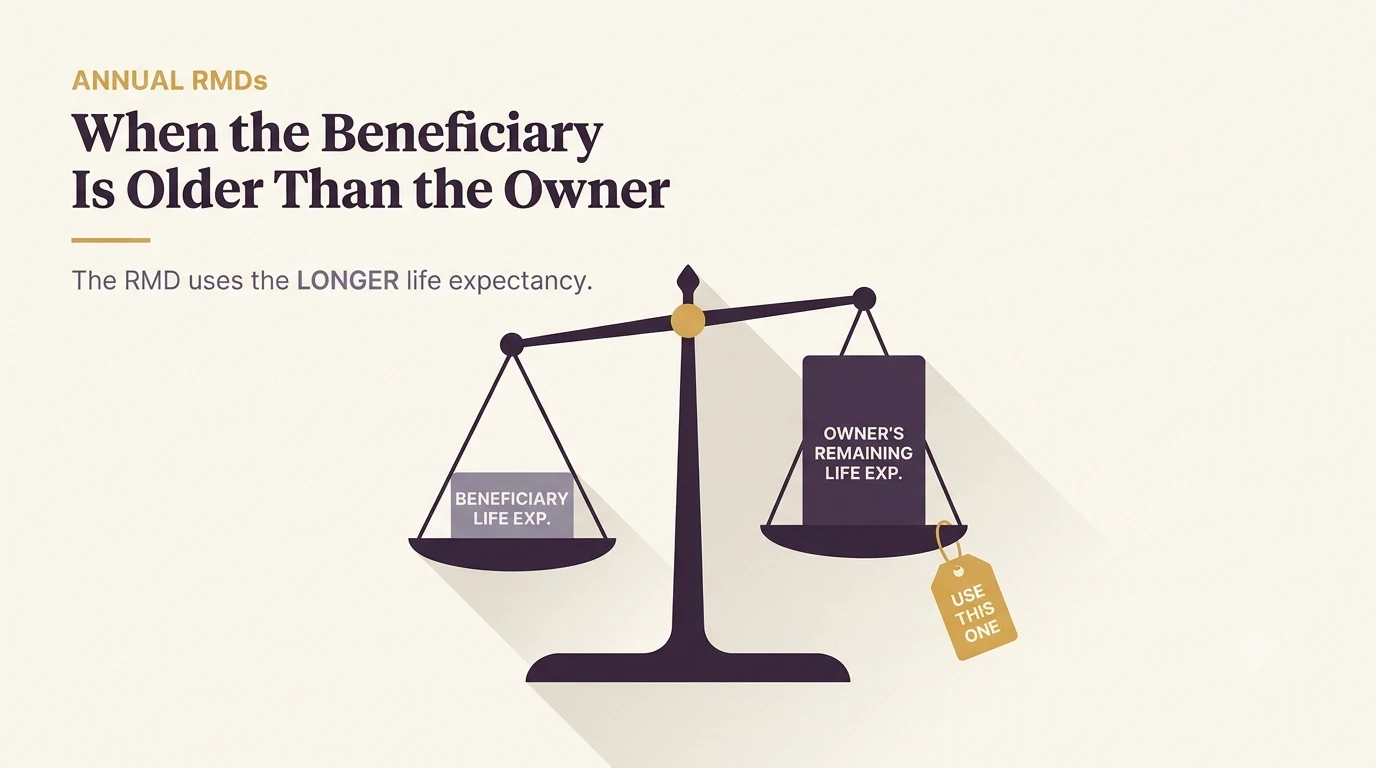
An older beneficiary passes the age-gap EDB test—but that is only step one
The statutory category is “not more than 10 years younger,” not “within 10 years of the owner.” An individual beneficiary who is older than the deceased owner is therefore within the age-gap EDB category. That classification can allow life-expectancy treatment, but it does not tell you which life expectancy controls the annual RMD.
After an on/after-RBD death, compare two remaining life expectancies
Publication 590-B says that when the owner dies on or after the required beginning date and there is a designated beneficiary, post-death RMDs are based on the longer of the beneficiary’s single life expectancy or the owner’s remaining life expectancy. For an older beneficiary, the owner’s track can easily be the longer denominator.
That matters because dividing by a longer denominator generally produces a smaller annual minimum. Looking up only the older beneficiary’s age can therefore overstate the required distribution.
Worked setup: 82-year-old sibling, 78-year-old owner
Assume an owner dies in 2026 at age 78 after the required beginning date and leaves the IRA to an 82-year-old sibling. The sibling clears the age-gap EDB test because the sibling is older, not younger. For the post-death RMD, the file should show two candidate tracks:
| Candidate | Starting point | Why keep it |
|---|---|---|
| Beneficiary life expectancy | Beneficiary age under Table I for the applicable starting year | One candidate denominator |
| Owner remaining life expectancy | Owner age in the year of death, then reduced as required | Second candidate denominator |
| Selected denominator | The longer remaining life expectancy | Supports the annual RMD calculation |
The exact table factors depend on the applicable calendar year. The important workflow is to preserve both calculations and select the longer track instead of assuming the beneficiary’s age always controls.
Death before the required beginning date uses a different branch
If the owner died before the required beginning date, an EDB generally begins life-expectancy payments under the beneficiary rules, subject to the options allowed by the IRA or plan. The owner’s remaining life expectancy is not used in the same longer-of comparison because the owner had not reached the post-RBD branch.
Do not revive the proposed “older beneficiary” full-distribution rule
The final 2024 regulations removed a proposed rule that would have forced full distribution when a hypothetical beneficiary denominator reached one or less in certain older-beneficiary cases. An article or worksheet based on the proposal can therefore impose a deadline that is not in the final rule.
Successor treatment is a separate clock question
If the older EDB later dies with money still in the account, the successor beneficiary generally does not restart the schedule using the successor’s own life expectancy. The remaining inherited interest moves into the successor rules, including a 10-year full-distribution period measured from the EDB’s death where applicable, while annual payments can continue under the inherited schedule.
How to compute the owner track precisely
The owner's remaining life expectancy starts with the owner's age on the birthday in the year of death, read against the Single Life Expectancy Table. That factor is then reduced by one for each calendar year after the year of death. Example: an owner who would have turned 78 in the year of death has a starting factor near 12.6; the year-after-death denominator is about 11.6, the next year about 10.6, and so on. The beneficiary track is built the same way from the beneficiary's own first-year age. The larger of the two current-year factors is the denominator.
When the custodian offers only the beneficiary factor
Many custodial systems default to the beneficiary's Single Life factor and do not run the comparison. If the owner died on or after the required beginning date, ask the institution in writing whether it compared the two tracks, and supply the owner's date of birth if it is missing from the account record. For an older beneficiary this is exactly the situation where the owner track is likely to be the longer one and the default calculation overstates the RMD.
Many custodial systems default to the beneficiary's Single Life factor. If the owner died on or after the required beginning date, ask in writing whether both tracks were compared, and supply the owner's date of birth if it is missing.
A better annual worksheet for an older EDB
- Confirm EDB status from the age-gap rule.
- Record whether the owner died before or on/after the required beginning date.
- If on/after RBD, calculate both remaining-life-expectancy candidates.
- Use the longer denominator for the annual RMD.
- Carry forward the selected track under the reduction rules for later years.
- Keep the original owner’s death date and any successor deadline separate from the annual denominator calculation.
This article’s key point is not merely that an older beneficiary can be an EDB. It is that EDB classification and annual denominator selection are two different decisions, and the second decision is where older beneficiaries are most often miscalculated.