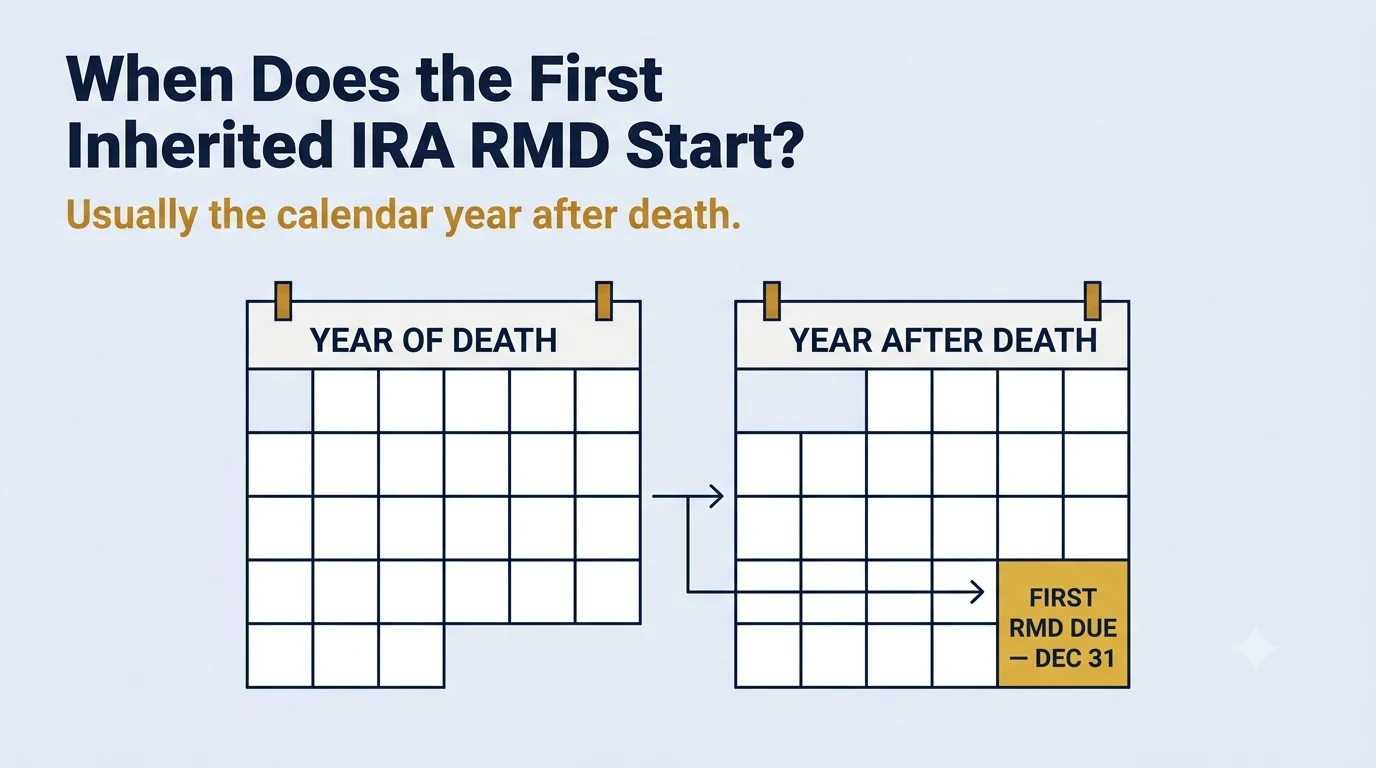
There is no single “first inherited IRA RMD” date for every beneficiary
The first annual post-death distribution depends on two facts: whether the owner died before or on/after the required beginning date (RBD), and whether the beneficiary is an eligible designated beneficiary (EDB) or an ordinary designated beneficiary subject to the 10-year rule. The owner’s unpaid year-of-death RMD is a separate obligation and should not be mixed into the beneficiary’s first post-death calculation.
Decision table: what happens in the calendar year after death?
| Owner / beneficiary branch | Annual beneficiary RMD in year after death? | Outer deadline |
|---|---|---|
| Owner died before RBD; ordinary designated beneficiary | No annual amount merely because of the 10-year rule | Full distribution by year 10 |
| Owner died on/after RBD; ordinary designated beneficiary | Generally yes | Annual RMDs plus full distribution by year 10 |
| EDB using life-expectancy treatment | Generally yes, beginning in the year after death | Depends on EDB/successor rules |
First close the owner’s year-of-death RMD
If the owner had an RMD for the year of death and had not withdrawn the full amount, the remaining year-of-death requirement must be handled for that same calendar year. IRS RMD guidance treats that as the amount the owner would have been required to withdraw but did not. It is not the beneficiary’s first life-expectancy RMD.
Keep a separate line in the file for: (1) owner year-of-death RMD, (2) first beneficiary RMD, and (3) final 10-year deadline if applicable.
Branch 1: owner died before RBD and beneficiary is an ordinary designated beneficiary
Publication 590-B says that when the owner died before RBD and the 10-year rule applies, no distribution is required in years 1 through 9 merely because of that rule. In this branch, asking “what is my first annual RMD?” can be the wrong question. There may be no annual minimum; the legal requirement is to empty the account by December 31 of the year containing the tenth anniversary of death.
Branch 2: owner died on or after RBD and beneficiary is an ordinary designated beneficiary
The 2024 final regulations preserve annual post-death RMDs while the 10-year clock runs. The first beneficiary annual calculation is generally for the calendar year after death. It uses the inherited-account balance and the applicable post-death denominator, while the separate year-10 deadline remains in force.
Branch 3: EDB using life expectancy
An EDB who uses life-expectancy treatment generally begins annual distributions by the end of the calendar year following the owner’s death, subject to special spouse rules outside this site’s nonspouse focus. For a nonspouse beneficiary, the starting denominator comes from the beneficiary rules in Publication 590-B and the final regulations.
Example: November death after RMDs had already begun
An owner dies November 20, 2026 after taking $12,000 of a $20,000 lifetime RMD. The remaining $8,000 belongs to the 2026 owner-year obligation. If the beneficiary is an ordinary nonspouse designated beneficiary and the owner died after RBD, the beneficiary then has a separate 2027 post-death RMD. Those amounts should never be combined into one worksheet line because they arise in different calendar years under different rules.
- 2026Example owner dies November 20; $8,000 of the owner's RMD remains for this year.
- 2027If applicable, the beneficiary has a separate first post-death RMD.
- Year 10Track the final full-distribution deadline separately if the 10-year rule applies.
If you are not sure whether the owner had started RMDs
Two quick checks resolve most cases. First, look for a Form 1099-R issued to the decedent for the prior year—an owner taking lifetime RMDs would have one. Second, compare the owner's birth year against the RMD-age rules: an owner born 1951–1959 reaches the required beginning date at 73, and the first RMD is due by April 1 of the year after turning 73. An owner who died at 70 with no prior 1099-R almost certainly died before the required beginning date, which points to Branch 1.
Look for a Form 1099-R issued to the decedent for the prior year; an owner taking lifetime RMDs would have one. Then compare the owner's birth year with the RMD-age rules: an owner born 1951 through 1959 reaches the required beginning date at age 73.
Late-year deaths shorten the setup window, not the tax-law deadline
A December death can leave only days before the first beneficiary RMD year begins on January 1. The beneficiary still generally has until the end of that following calendar year to receive the annual amount, but beneficiary paperwork, account registration, and prior-year-end balance records should be requested early.
Build the tracker around calendar years
- Record the owner’s date of death and RBD status.
- Determine whether a year-of-death RMD remains unpaid.
- Classify the beneficiary as EDB or ordinary designated beneficiary.
- Mark whether the following year has an annual RMD under the table above.
- Record the applicable denominator and prior-year-end balance if an annual RMD is due.
- Keep the final year-10 deadline on a separate line.
This structure answers the actual search intent—when does the first beneficiary distribution become mandatory?—without repeating the full year-of-death RMD calculation.