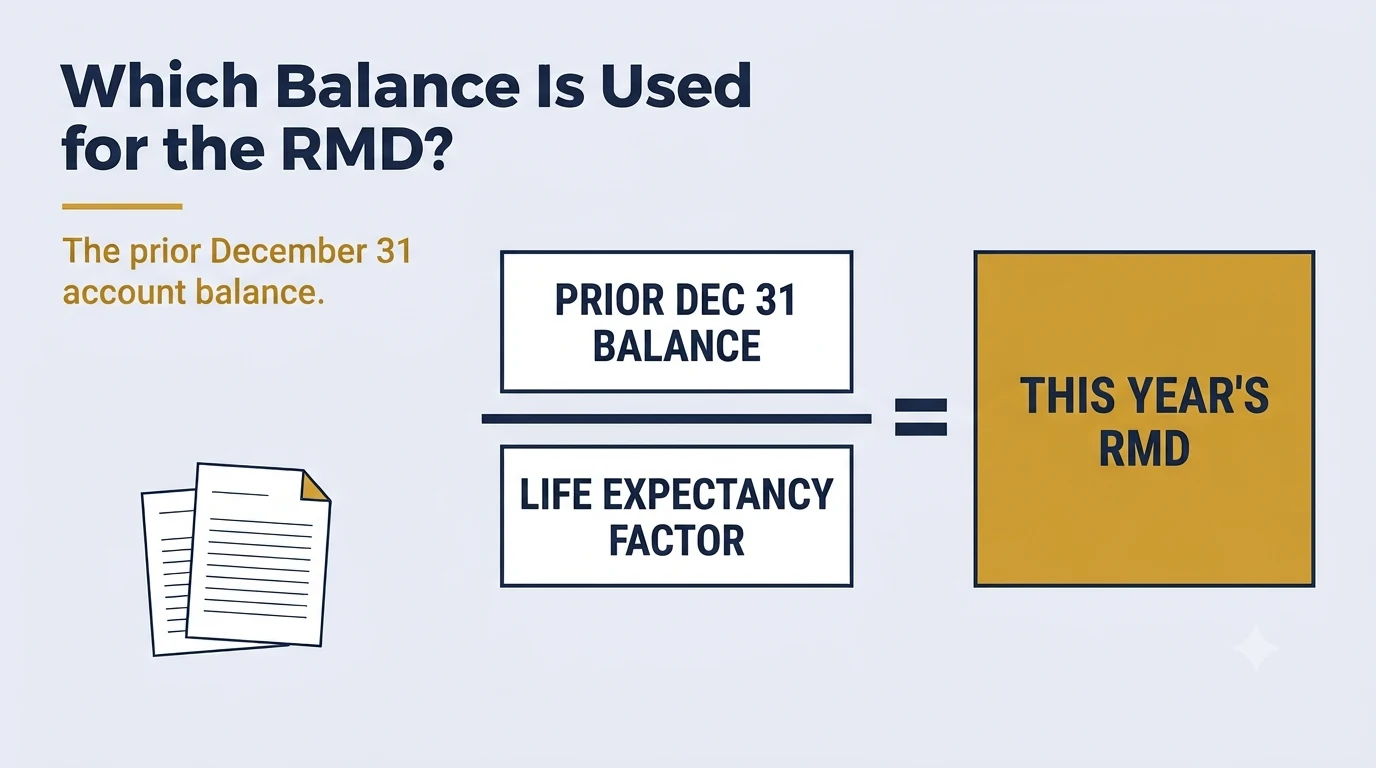
The calculation generally starts with the prior December 31 value
An inherited-IRA RMD is generally calculated using the account balance as of the close of business on December 31 of the preceding year, divided by the applicable distribution period. That makes the prior-year-end statement a key tax record rather than just an investment statement.
Do not substitute today’s market value
If the account was worth $500,000 on December 31 and falls to $430,000 by March, the RMD calculation is not normally recomputed using the March value simply because the market declined. Conversely, a market gain during the year does not cause a midyear recalculation. The annual formula anchors to the prescribed valuation date.
The article's example: the annual formula anchors to the prescribed valuation date.
Transfers can split the records between two institutions
A beneficiary who transfers an inherited IRA in February may receive the current account from Custodian B while the relevant December 31 value still sits on Custodian A’s final statement. The receiving institution may not automatically know that prior balance. Keep the old year-end statement with the new account records.
Example: transfer after year end
Assume an inherited IRA is worth $360,000 on December 31, 2026 and is moved trustee-to-trustee to another custodian in February 2027. The 2027 RMD calculation still begins with the relevant December 31, 2026 value, subject to any regulatory adjustments that apply. The February transfer itself does not reset the valuation date.
- December 31, 2026Example inherited IRA value is $360,000.
- February 2027Account transfers to another custodian.
- 2027 RMD calculationStill starts with the relevant December 31, 2026 value, subject to adjustments.
What if the statement is missing?
- Request a duplicate year-end statement from the former custodian.
- Ask for a transaction history showing the closing December 31 value if a statement is unavailable.
- Preserve evidence of any year-end transfer in transit.
- Do not estimate a balance from a later statement unless a qualified adviser confirms the required adjustment.
Balance is only half the formula
A correct year-end value cannot fix an incorrect denominator. Beneficiaries subject to annual RMDs also need the applicable life-expectancy denominator, including the longer-of comparison when the owner died on or after the required beginning date. Keep the balance source and denominator workpaper together.
Why the final year is different
For an ordinary designated beneficiary under the 10-year rule, the final requirement is to distribute the entire remaining account by the year-10 deadline. A life-expectancy minimum earlier in that year does not replace the full cleanout obligation. The December 31 prior-year balance remains useful for the annual minimum calculation, but the beneficiary also has to monitor the actual remaining balance during year 10.
Year-end transfers in transit require special record attention
If assets are moving between trustees around December 31, a beneficiary may receive statements from both institutions and see a temporary cash or securities-in-transit position. Do not simply add or omit values based on which dashboard shows the assets on January 2. Preserve transfer confirmations and ask the institutions how the December 31 fair market value was reported for RMD purposes.
The figure is fair market value, including hard-to-value assets
For an inherited IRA that holds only publicly traded securities and cash, the December 31 statement value is straightforward. If the account holds real estate, a private note, a closely held business interest, or another illiquid asset, the prior-year-end value is the custodian's fair market value—often based on a dated appraisal. A stale or missing valuation directly distorts the RMD, so a beneficiary with an illiquid inherited IRA should confirm the custodian obtained a current year-end valuation.
Amounts in transit at year end can require an add-back
If an amount left one account through a rollover or transfer that had not yet been received by the destination account on December 31, the RMD rules can require that in-transit amount to be added back to the relevant year-end balance so it is counted once. This mostly affects a beneficiary who moved an account right at year end. Keep the outbound and inbound confirmations together and ask each custodian how it reported the December 31 value.
Outstanding distributions can affect what the statement shows
A check issued in late December, a distribution still pending, or unsettled securities can make the visible account balance confusing. The RMD rules use prescribed valuation principles, not a beneficiary’s estimate of “what I think was still invested.” This is another reason to keep the official year-end valuation from the custodian.
Make the valuation source part of the worksheet
Record not only the dollar balance but also the statement date, institution, account number suffix, and any adjustment supplied by the custodian. Five years later, a bare spreadsheet cell reading “$486,220” is much harder to defend than a calculation tied to a saved December 31 statement.
- Record the balance and statement date.
- Save the custodian name and account suffix.
- Keep year-end transfer confirmations from both institutions.
- Ask how in-transit assets and outstanding distributions were valued.
- Save any adjustment supplied by the custodian with the RMD calculation.