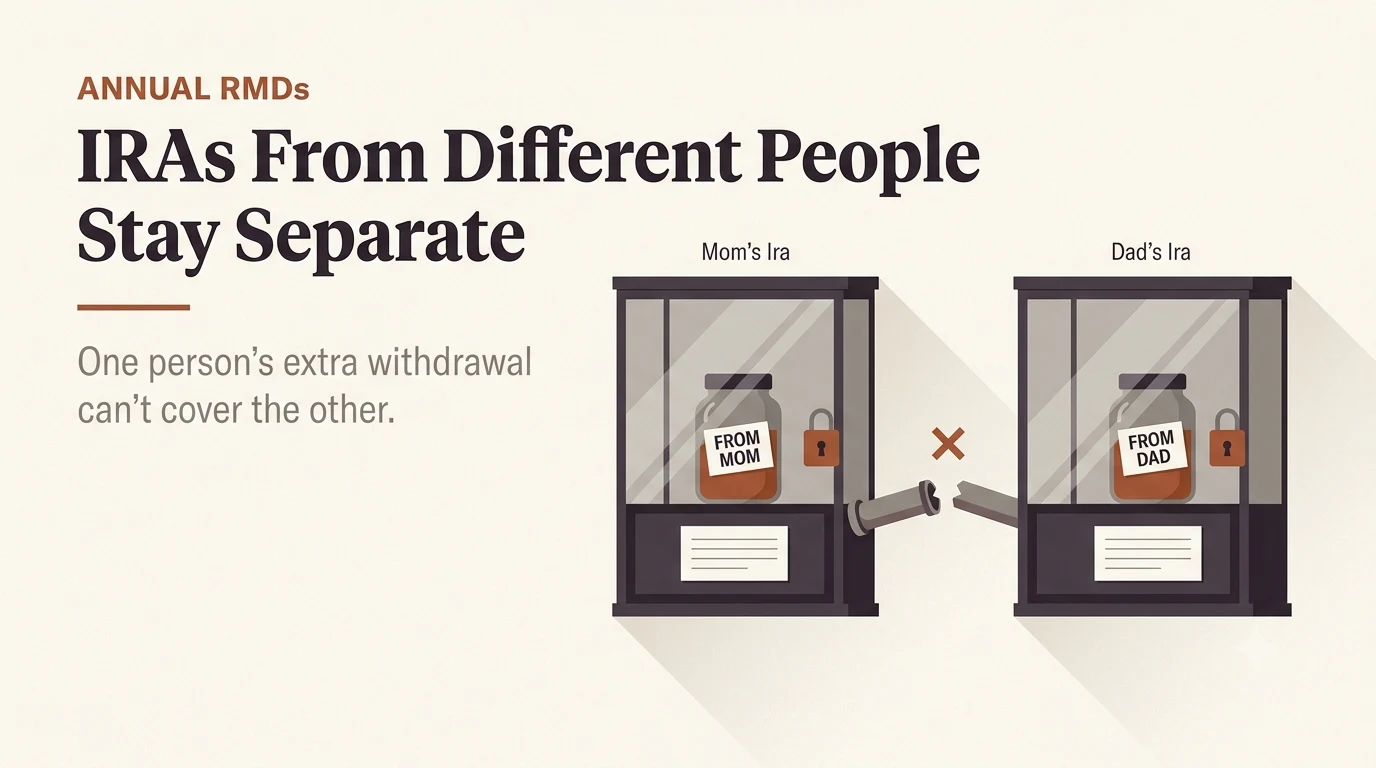
The same-decedent rule creates a hard boundary
IRS Form 5329 instructions state that inherited IRA distributions can be combined to satisfy RMDs only for inherited IRAs from the same decedent, subject to the applicable IRA category rules. If one account came from a mother and another from an uncle, an excess withdrawal from the mother’s inherited IRA does not satisfy the uncle account’s RMD.
Mistake scenario 1: the beneficiary withdraws the combined total from the wrong decedent
Assume the mother group has a $9,000 RMD and the uncle group has a $4,000 RMD. The beneficiary withdraws $13,000 from the mother’s inherited IRA and nothing from the uncle’s account. The mother group has an extra $4,000 distribution, but the uncle group still has a $4,000 shortfall. A spreadsheet note saying “$13,000 total RMD taken” does not fix the mismatch.
What to do if the error is found before December 31
If the beneficiary catches the mistake before year end, identify the actual shortfall for the uncle group and arrange a distribution from an account that is eligible to satisfy that group. Keep the original mother-account distribution as what it was—an extra distribution from the mother group. Do not try to relabel the source after the fact.
What changes if the error is found after year end
After the deadline, the beneficiary should analyze the actual missed amount under the RMD excise-tax rules and Form 5329 instructions. The excess from the other decedent does not migrate across accounts retroactively. Correction, reduced excise-tax treatment, or a reasonable-cause waiver analysis must be tied to the group that had the shortfall.
Mistake scenario 2: both decedents died in the same year
Matching death years do not create one RMD pool. If both parents die in 2026 and each leaves an inherited IRA to the same child, each parent remains a separate decedent for aggregation. The beneficiary may also have different beneficiary classifications, basis records, or year-of-death RMD facts for the two accounts.
Mistake scenario 3: one brokerage dashboard hides the legal distinction
A custodian may display several inherited accounts under one login. Before submitting a withdrawal, verify the legal source account and the decedent attached to it. Tax reporting follows the account that actually distributes the money, not the beneficiary’s private intention to “apply” the withdrawal somewhere else.
Different decedents also mean separate long-term clocks
| Field | Mother | Uncle |
|---|---|---|
| Year of death | 2022 | 2026 |
| Potential year-10 endpoint | 2032 | 2036 |
| Annual RMD history | Separate | Separate |
| Basis/Form 8606 records | Mother only | Uncle only |
Even if both accounts use similar annual formulas, the records cannot be merged without losing the facts that determine each account’s compliance.
Different decedents can also mean different distribution regimes
Two inherited IRAs from different people can sit under entirely different rules. The mother's account might be a 10-year account with no annual RMD (she died before her required beginning date), while the uncle's account requires annual RMDs (he died after his). Trying to satisfy one from the other is not just a paperwork error—it can mean taking a distribution that was never required from one account while missing a required one from the other.
| Inherited account | Mother’s IRA | Uncle’s IRA |
|---|---|---|
| Owner’s status at death | Before required beginning date | After required beginning date |
| Distribution rule described | 10-year account with no annual RMD | Annual RMDs required |
| Where its distribution counts | Mother’s decedent group only | Uncle’s decedent group only |
A single 1099-R per account is the reconciliation anchor
Each inherited IRA generates its own Form 1099-R showing what that account distributed. When the year closes, match every 1099-R to its decedent group and confirm that group's required total was met by distributions from within the group. If the numbers do not line up, the fix has to happen inside the group that fell short, using the correct year's Form 5329 if the deadline has already passed.
Keep the beneficiary’s own IRA outside both inherited groups
For a nonspouse beneficiary, inherited IRAs remain beneficiary accounts. Do not combine a personal traditional IRA RMD with a mother group or uncle group merely because the same taxpayer owns all three accounts.
Traditional and Roth inherited accounts need an additional label
The Form 5329 instructions separately address traditional inherited IRAs and inherited Roth IRAs from the same decedent. A robust worksheet therefore uses two identifiers before aggregation: decedent and account tax category. That prevents a valid same-decedent rule from being stretched too far.
A correction-ready worksheet
- Decedent full name and date of death.
- Each inherited account number and tax category.
- Account-level RMD calculation.
- Gross distributions actually taken from that decedent’s eligible group.
- Remaining shortfall before year end.
- Form 5329/correction notes if the deadline was missed.