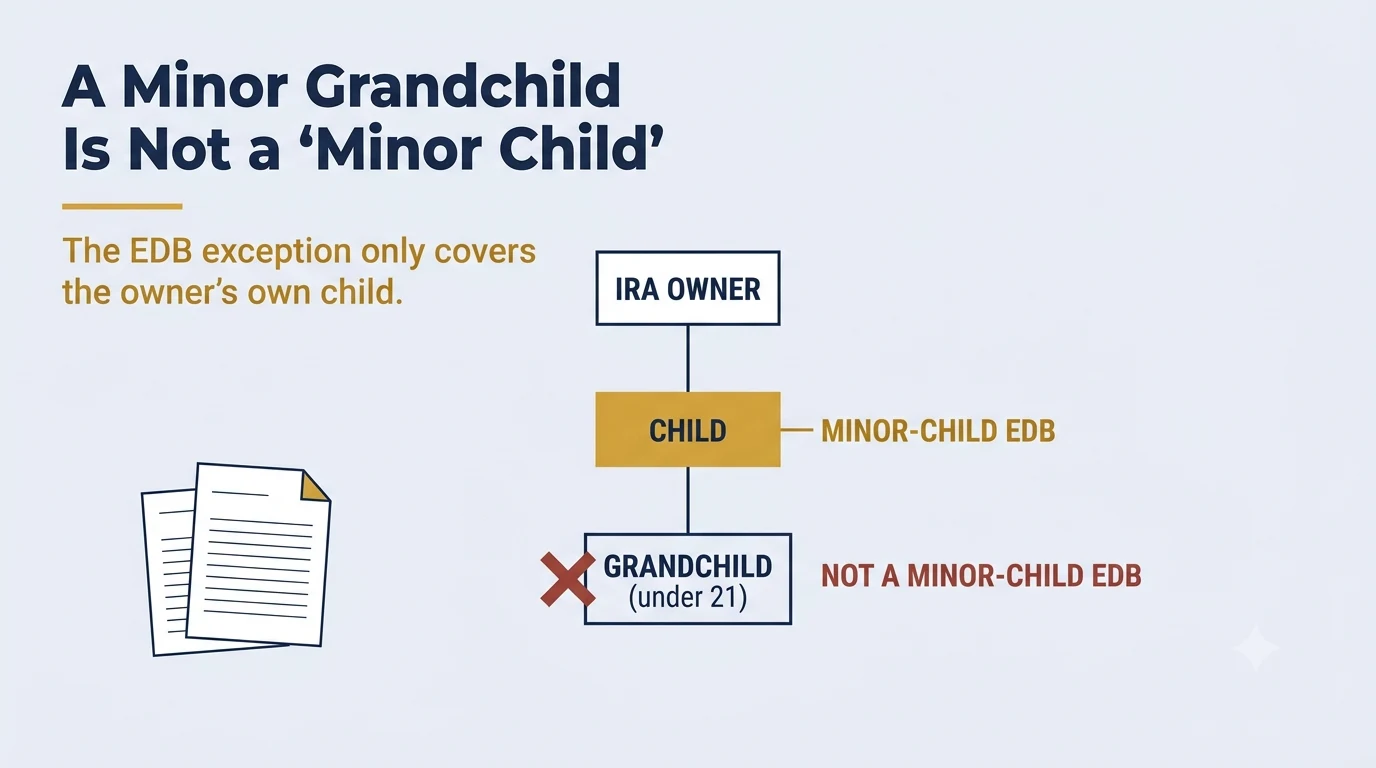
The federal RMD rule asks whose child the beneficiary is
A common mistake is to read “minor child” as “any beneficiary who is a minor.” The final regulations are narrower. The eligible-designated-beneficiary category applies to a child of the deceased employee or IRA owner who has not reached age 21. A grandchild who is 12, 16, or 20 is not the owner’s child merely because the beneficiary is a minor.
That means a young grandchild can be an ordinary designated beneficiary subject to the 10-year rule immediately after the grandparent’s death.
Example: a 15-year-old grandchild inherits directly
Assume a grandparent dies in 2026 and names a 15-year-old grandchild directly as beneficiary of a traditional IRA. The beneficiary is an individual and therefore can be a designated beneficiary, but the minor-child EDB exception does not arise from the grandchild relationship. If the grandchild is not disabled or chronically ill, and is more than 10 years younger than the grandparent, the ordinary designated-beneficiary rule generally applies.
The account therefore has a year-10 outside deadline measured from the grandparent’s death, not from the grandchild’s 21st birthday.
The owner’s RMD status still controls whether annual distributions are required
If the grandparent died before the required beginning date, the 10-year rule generally does not itself require distributions in years 1 through 9. If the grandparent died on or after the required beginning date, the final regulations generally require annual beneficiary RMDs during the 10-year period as well.
This creates an important contrast with the owner’s own minor child, who may begin under life-expectancy treatment and then move into a 10-year period at age 21.
A grandchild can qualify under another EDB category
The family label is not the end of the analysis. A grandchild who was disabled or chronically ill as of the owner’s death may be an EDB for that separate reason. The “not more than 10 years younger” category can also apply in unusual family structures, although it will rarely help a typical grandchild because the age gap is usually much larger than 10 years.
The grandchild's 10-year clock does not pause for minority
This is the practical sting. The owner's own minor child gets life-expectancy payments until 21 and only then starts a 10-year period. A grandchild gets no such pause: the 10-year clock runs from the grandparent's death regardless of the grandchild's age. A grandchild who inherits at age 10 generally must have the account fully distributed by around age 20, and if the grandparent died on or after the required beginning date, annual RMDs are due in the meantime.
- 2026Grandparent dies; the ordinary 10-year period can begin.
- Year 1 through year 9Annual RMDs generally apply if the owner died on or after RBD.
- Year 10The account is due by the end of the period, regardless of the grandchild's age.
Naming the grandchild through a trust does not change the classification
Routing the IRA to a see-through trust for the grandchild does not convert the grandchild into the owner's child. The trust analysis still looks through to the grandchild's own status, and a healthy minor grandchild remains an ordinary designated beneficiary. A UTMA custodial registration is the same: the custodian is just an adult authorized to transact, not a change in who the beneficiary is.
Why this matters for custodial accounts and guardians
A minor beneficiary may need a guardian, custodian, or other legally authorized adult to complete financial-institution paperwork. That state-law administration issue is separate from the federal RMD classification. A custodian for the child does not transform the child into the deceased owner’s “minor child” for SECURE Act purposes.
When the beneficiary cannot legally transact on the account alone, the family should obtain institution-specific instructions early enough that an annual RMD deadline is not missed while guardianship or custodial paperwork is being resolved.
Three dates belong on the file
- The grandparent’s date of death, because it starts the ordinary 10-year period if that rule applies.
- The grandparent’s required beginning date status, because it affects annual RMDs.
- The beneficiary’s birth date, because it can still matter for the Single Life Table when annual beneficiary RMDs must be calculated.
Do not import the age-21 deadline from a different beneficiary category
If an article or custodian representative says “the 10-year clock starts when a minor turns 21,” confirm that the beneficiary is actually the deceased owner’s child. That statement is not a general rule for nieces, nephews, grandchildren, unrelated minors, or a minor beneficiary of a trust.
For the actual age-21 transition, see Minor Child Inherits an IRA: What Changes When the Child Turns 21?.
- Confirm who can legally transact for the minor with the custodian.
- Ask the institution early for its guardian or custodian paperwork so an annual RMD deadline is not missed.
- Test the other EDB categories instead of relying on the grandchild relationship.
- Do not apply the owner's-child age-21 transition without the qualifying relationship.
Classification summary
| Beneficiary | Minor-child EDB category? | Other EDB tests still possible? |
|---|---|---|
| Owner’s 17-year-old child | Generally yes | Yes |
| Owner’s 17-year-old grandchild | No, not by that relationship | Yes |
| Owner’s 17-year-old niece | No | Yes |
| Owner’s 22-year-old child | No, already reached majority for this rule | Yes |
The useful habit is to classify the beneficiary from the statute and regulations, not from everyday language about who is a “minor.”