Table I is the beneficiary table for nonspouse life-expectancy calculations
Publication 590-B includes three life-expectancy tables, but nonspouse beneficiary calculations generally use Table I, the Single Life Expectancy table. The critical task is not merely finding a number next to the beneficiary’s current age. The beneficiary must identify the correct initial year, the correct age for that year, and then follow the reduction rule for later years.
The first beneficiary year establishes the starting denominator
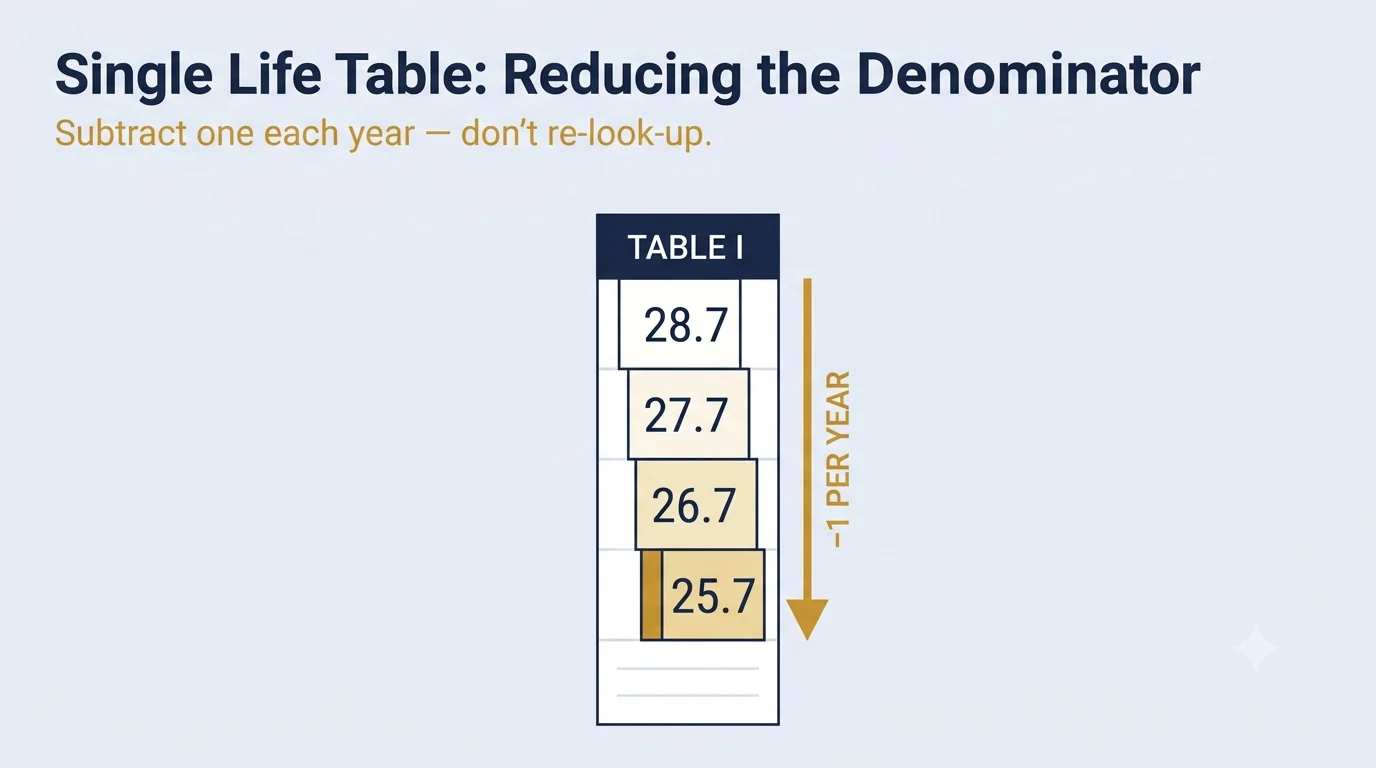
For an eligible designated beneficiary taking life-expectancy payments after the owner’s death, Publication 590-B generally looks to the beneficiary’s age in the year following the owner’s death—the year distributions begin—to find the initial Table I denominator. After that starting amount is established, the denominator is generally reduced by one for each subsequent year rather than re-looked-up from the table at the beneficiary’s new age.
Example: beneficiary turns 57 in the first RMD year
Publication 590-B gives an example in which an eligible designated beneficiary turns 57 in the first distribution year and uses the Table I value for age 57. The beneficiary then reduces that starting denominator by one in later years. The arithmetic is mechanical once the correct starting year is documented.
Owner died on or after RBD: Table I may be only one side of the comparison
If the owner died on or after the required beginning date, the post-death rule generally compares the beneficiary’s single life expectancy with the owner’s remaining life expectancy and uses the longer period. A beneficiary should therefore not stop after finding a Table I number. The owner-side denominator has to be calculated too.
That comparison is covered in the longer-of rule guide.
- Find the first distribution yearThe initial beneficiary factor generally uses age in the year after the owner's death.
- Look up the Table I factorUse the Single Life Expectancy Table for that age.
- Reduce the fixed factor each later yearGenerally subtract one instead of looking up a new attained age.
- Compare the owner track if requiredAn on-or-after-RBD death can require the longer-of calculation.
Do not use Table III just because that is what the owner used while alive
Table III, the Uniform Lifetime table, is commonly used for an IRA owner’s lifetime RMDs. It is not automatically the beneficiary’s post-death table. A nonspouse beneficiary generally works with Table I, while the owner’s remaining life expectancy can be relevant in the post-RBD comparison.
Prior-year-end balance is the numerator
The denominator is only half of the calculation. The annual RMD generally divides the prior December 31 account balance by the applicable denominator. If an inherited account was transferred between custodians, the beneficiary should preserve the prior-year-end value from the old institution and any adjustments required under the regulations.
Extra withdrawals do not alter next year’s denominator rule
Taking more than the required minimum can reduce the account balance that remains at year end, but it does not create a credit against future RMDs and does not change the required one-per-year reduction of a fixed life-expectancy denominator. Account balance and denominator move under different rules.
A simple annual worksheet
| Line | Entry |
|---|---|
| 1 | Prior December 31 inherited-IRA balance |
| 2 | Initial Table I denominator or prior-year denominator minus one |
| 3 | Owner remaining-life denominator, if the longer-of rule applies |
| 4 | Applicable denominator after comparison |
| 5 | RMD = line 1 divided by line 4 |
| 6 | Actual distributions received during the calendar year |
Keep the first-year worksheet forever
Later RMDs often depend on the denominator established years earlier. If the beneficiary changes custodians in year 6, the new institution may not have the original calculation. Saving the first-year age, table value, owner comparison, and each annual reduction creates a chain that can be reconstructed without guessing.
Do not go back to the table every year and look up a new age
For many post-death beneficiary calculations, the initial life-expectancy factor is established from the Single Life Table and then reduced by one for each succeeding year. Re-looking up the beneficiary’s attained age in the table every year can produce a different denominator path from the rule that actually applies.
Example of a fixed denominator track
Assume the beneficiary’s properly established starting factor for the first distribution year is 35.0. Subject to the applicable rule, the next year’s factor is generally 34.0, then 33.0, rather than a fresh table lookup based on the beneficiary’s new age. When an owner-life-expectancy comparison is also required, keep a second track and compare the two applicable denominators.
Beneficiaries who started before 2022 had a one-time reset
The IRS updated the life-expectancy tables effective for 2022. Beneficiaries who were already taking life-expectancy distributions under the old table were allowed to reset: re-read the table using the age at which distributions originally began, take the new (slightly longer) factor for that age, then subtract one for each year that has since passed. A beneficiary who inherited in, say, 2018 and never applied that reset may be using a denominator that is one to two years too short, which overstates every RMD since 2022.
Transfers are where denominator history often gets lost
A new custodian can see today’s age and today’s balance but may not know the factor established five years earlier. Save the first-year worksheet, not just the annual dollar RMD. If a prior institution used an incorrect starting age or table, correcting the history may require recalculating multiple years.
- Save the first-year age and Table I value.
- Keep the owner-side comparison if required.
- Record each annual one-point reduction.
- Save the prior-year-end balance and any adjustment.
- Keep the original worksheet when changing custodians.