Short answer: the temporary 2021–2024 relief is not a standing 2025 or 2026 waiver
Some beneficiaries heard that the IRS would not assess the excise tax for certain missed inherited-account RMDs during 2021 through 2024 while the 10-year-rule regulations were being finalized. That was time-limited transition relief for defined situations and years. It is not a blanket waiver for an inherited IRA distribution missed in 2025 or 2026. The final required-minimum-distribution regulations apply when determining RMDs for calendar years starting January 1, 2025.
A later missed amount may still qualify for a different path: the statutory reduced tax after timely correction, a reasonable-cause waiver that the IRS reviews, or a narrow automatic waiver for a qualifying unpaid RMD in the calendar year the account owner died. Those routes have different requirements. “The IRS waived inherited IRA penalties before” is not enough to determine the result for a particular shortfall.
What the temporary notices actually covered
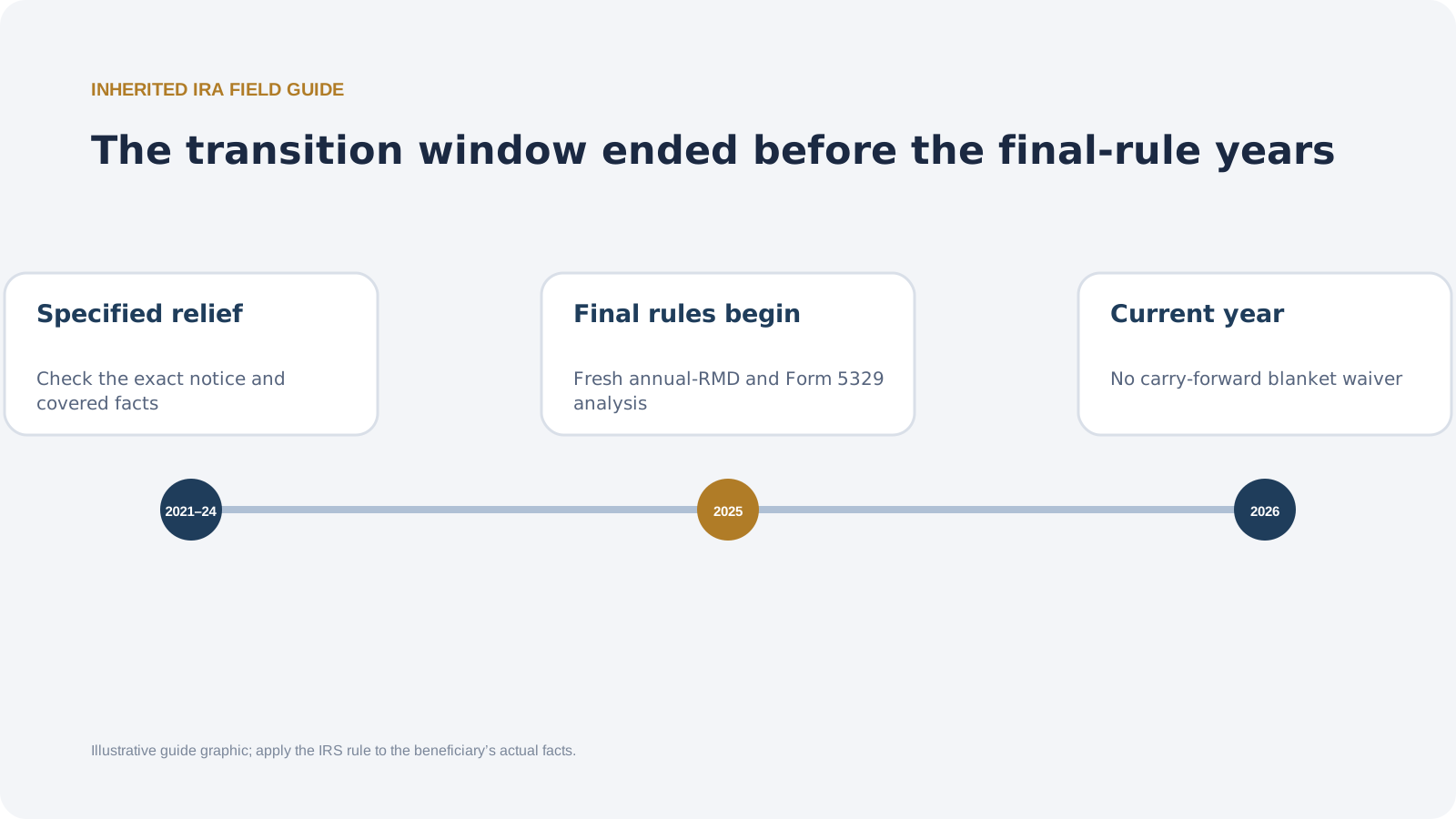
The transition notices responded to uncertainty about annual distributions during the 10-year period. The IRS issued relief for specified RMDs in 2021, 2022, and 2023, and Notice 2024-35 extended relief to certain specified 2024 RMDs. The 2024 notice says final regulations would apply for RMDs for calendar years beginning on or after January 1, 2025.
These notices did not erase every distribution rule for every beneficiary. They identify covered years and defined classes, including certain designated beneficiaries under the SECURE Act 10-year rule after an owner died on or after the required beginning date, plus certain successors of eligible designated beneficiaries. A person must check the notice that covered the particular year and beneficiary facts. A missed owner-year RMD, a missed EDB life-expectancy payment, and an ordinary 10-year-rule beneficiary’s payment are not automatically interchangeable cases.
Notice 2024-35 addresses 2024. It does not state that the same excise-tax nonassertion continues for 2025 or later. Treasury’s final regulations likewise specify that the revised RMD rules apply for calendar years beginning on or after January 1, 2025. Treat 2025 as the first year under the final regulatory regime rather than assuming the previous transition notices remain open-ended.
Why 2025 and 2026 need a fresh check
From 2025 forward, an ordinary designated beneficiary subject to the 10-year rule may need annual RMDs when the original owner died on or after the RBD, while the account also has to be emptied by the end of the tenth calendar year. The annual amount is not generally a flat tenth of the account. If the owner died before the RBD and the ordinary 10-year rule applies, Publication 590-B says no annual distribution is required in years before year 10 solely because of that 10-year rule. EDBs, spouses, trusts, and successor beneficiaries can follow different branches.
For a 2025 shortfall, use the 2025 rules and the 2025 version of Form 5329 instructions when determining how that year is reported. For a 2026 shortfall, use the rules and tax forms applicable to 2026; do not copy a 2025 form line or a 2024 notice into the next year. A missed RMD is measured against the amount actually required for that specific distribution year and the deadline for that year.
Three separate forms of relief are often confused
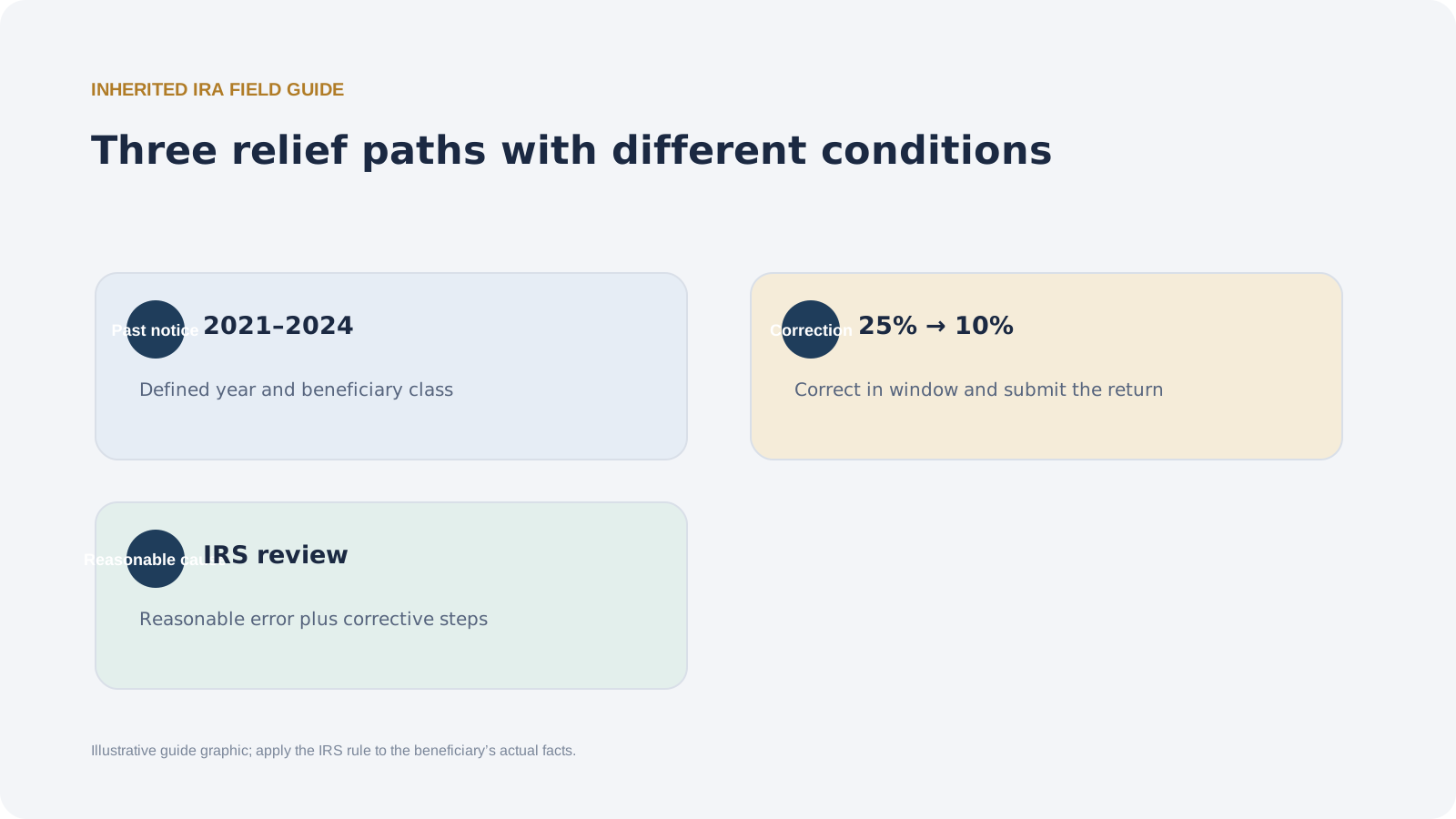
1. Historical transition relief. The IRS notices cover only specified RMDs in their listed calendar years and specified beneficiary situations. If a person qualifies, the notice’s treatment applies to that covered shortfall. It does not create a general grace period for later years.
2. Reduced 10% excise-tax rate after correction. The 2025 Form 5329 instructions explain a potential reduction from 25% to 10% when, during the correction window, the taxpayer receives the amount that caused the shortfall from the plan and submits a return reflecting the additional tax. The correction window has an outside limit but can end sooner if the IRS mails a deficiency notice or assesses the tax. The taxpayer should verify the applicable dates and filing posture.
3. Reasonable-cause waiver. The IRS can waive part or all of the excise tax if the shortfall resulted from reasonable error and the taxpayer is taking reasonable steps to remedy it. The instructions call for Form 5329 and an attached explanation, with “RC” and the amount requested for waiver entered in the specified manner. This is a request, not an automatic result. The IRS reviews the explanation and can deny it.
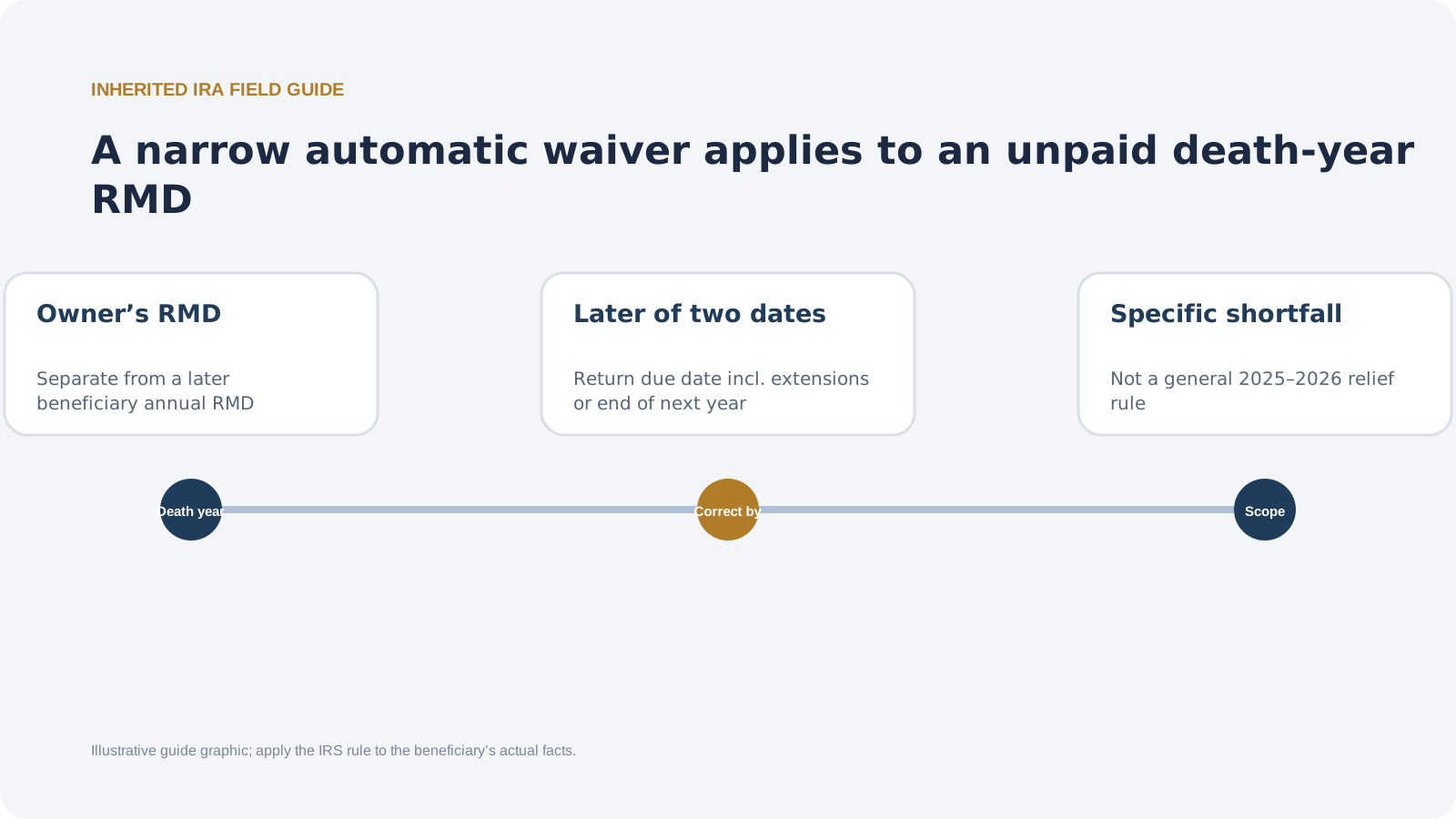
There is also a distinct automatic waiver rule for a missed RMD in the calendar year an individual dies. Under the final regulations, when a qualifying corrective distribution is made by the later of the beneficiary’s return due date, including extensions, for the beneficiary’s taxable year that begins with or within the calendar year of death, or the end of the following calendar year, the excise tax on that death-year shortfall is waived. This is narrow: it concerns the owner’s year-of-death RMD and its special corrective deadline. It should not be used as a general waiver for a later annual beneficiary RMD.
What to do after discovering a missed 2025 or 2026 payment
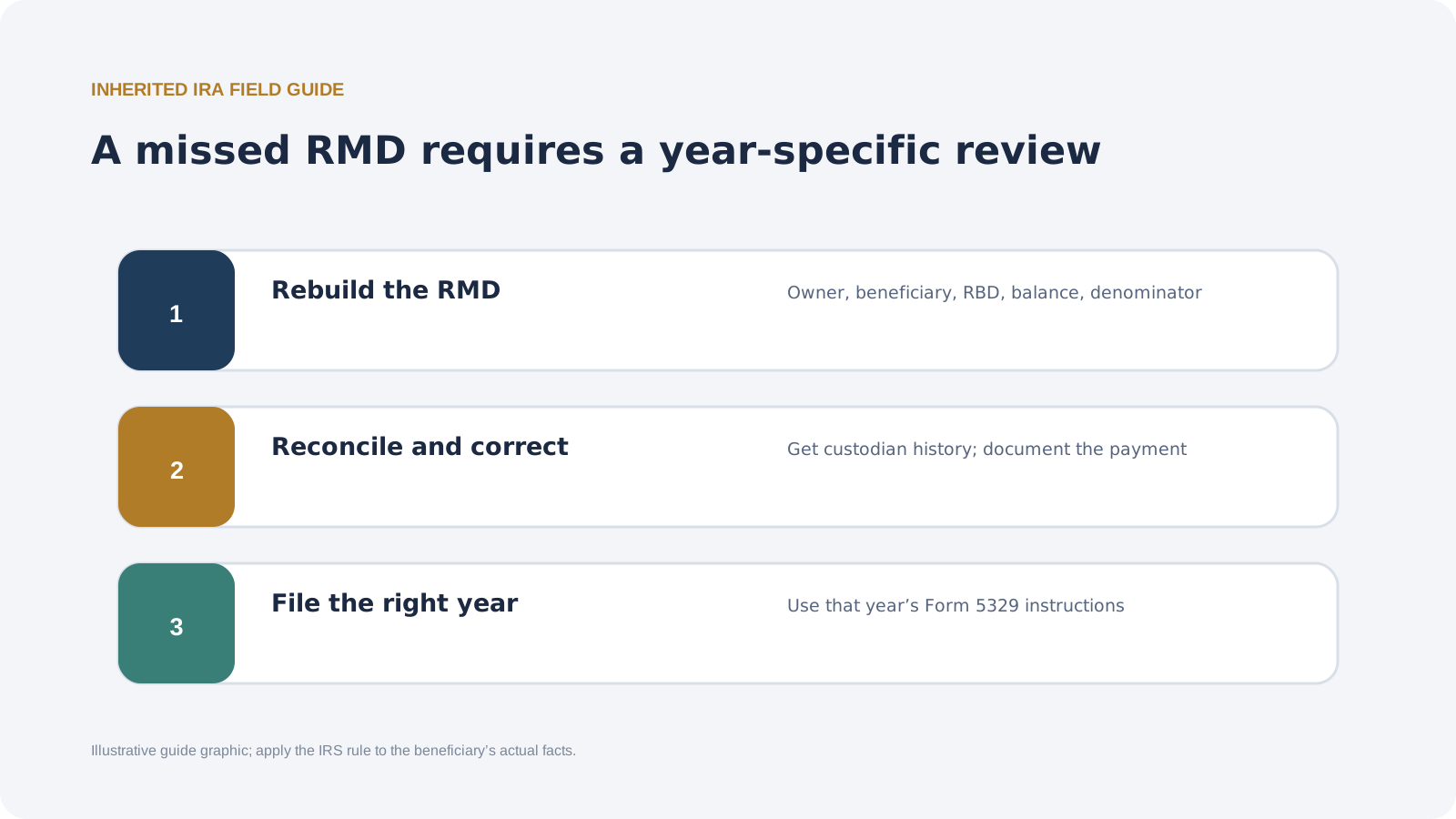
- Reconstruct the obligation. Identify the owner’s date of death, the owner’s RBD status, beneficiary category, account type, applicable denominator, prior-year-end balance, and required amount for the affected year.
- Reconcile actual payments. Obtain year-specific statements from every custodian. Check whether accounts may be aggregated for this beneficiary and decedent. Do not count a payment from a different decedent or a qualified plan unless its rules permit it.
- Correct the account shortfall promptly. Ask the custodian and tax professional what distribution is appropriate and document the date. A corrective payment can matter for the 10% rate and waiver analysis, but it does not change the original deadline.
- Use the right tax-year form. Form 5329 is generally filed with the corresponding year’s federal return when an excess accumulation tax or waiver request is involved. Use that tax year’s instructions rather than a later-year form.
- Request relief accurately, if appropriate. For reasonable-cause relief, include a factual explanation of why the error occurred, when it was found, what steps fixed it, and how future distributions will be made. The IRS decides whether the explanation qualifies.
How to document a reasonable-cause request
A useful record is specific and chronological. Preserve the custodian’s calculation, the inherited-account opening documents, the owner’s last statements, notices or advice received, communications showing the misunderstanding, the date the beneficiary discovered the shortage, and proof of the corrective distribution. Explain which information was missing or incorrect and what process changed to prevent another miss. Do not claim that a waiver is guaranteed or that simply paying late automatically removes the tax.
The correction window for the 10% rate and a reasonable-cause request are separate questions. A taxpayer might correct within the statutory window, request an IRS waiver for reasonable cause, or find that neither route fits. The applicable tax rate and any waiver depend on facts and current filing instructions. A CPA or enrolled agent can help classify the return and prepare the explanation.
Common transition-relief mistakes
- Assuming that Notice 2024-35 covers a 2025 or 2026 RMD because the beneficiary is still within a 10-year period.
- Assuming every beneficiary subject to the 10-year rule has annual payments in every year. The owner’s RBD status and beneficiary category matter.
- Confusing the owner’s unpaid RMD for the year of death with the beneficiary’s annual RMD for a later year.
- Treating the 10% corrected rate as an automatic waiver, or treating an “RC” notation as approved before the IRS reviews it.
- Filing a 2025 Form 5329 for a 2026 shortfall without checking the correct tax-year form and instructions.
A quick year-and-remedy comparison
For specified RMDs in 2021–2024, check the exact IRS notice and eligibility conditions. For a routine missed 2025 or 2026 annual RMD, start with the final regulations, the applicable Form 5329, and the 25%/potential 10% correction rules. For a missed RMD in the owner’s year of death, separately check the automatic deadline under the final regulations. These are three different pathways, not interchangeable labels for one universal penalty waiver.
The practical first call is to the custodian for the calculation history and year-specific payment record, followed by a tax professional for the form and relief analysis. If there is an approaching year-end deadline, act promptly; waiting for a tax notice can close off the correction window.
Questions about inherited IRA RMD relief
Does the 2024 IRS inherited IRA RMD relief cover a missed 2025 payment? Notice 2024-35 provides relief for certain specified 2024 distributions. It is not a blanket extension for a 2025 or 2026 RMD.
Can the IRS waive tax for a 2025 or 2026 missed RMD? The IRS may waive part or all of the tax for reasonable error when reasonable corrective steps are being taken. The taxpayer must follow the applicable Form 5329 instructions; approval is not automatic.
Does taking the late withdrawal automatically remove the penalty? No. A timely correction within the statutory correction window may qualify for the reduced 10% rate if the required return is submitted. A reasonable-cause waiver is a separate IRS decision.
Is an owner’s final-year RMD covered by the same rule? A special automatic waiver can apply to a qualifying unpaid RMD for the calendar year the owner died, if the corrective distribution is made by the prescribed later-of deadline. It is not a general waiver for subsequent beneficiary RMDs.
This guide is general educational information, not individualized tax or legal advice.