Start with the right 2026 account balance and beneficiary rule
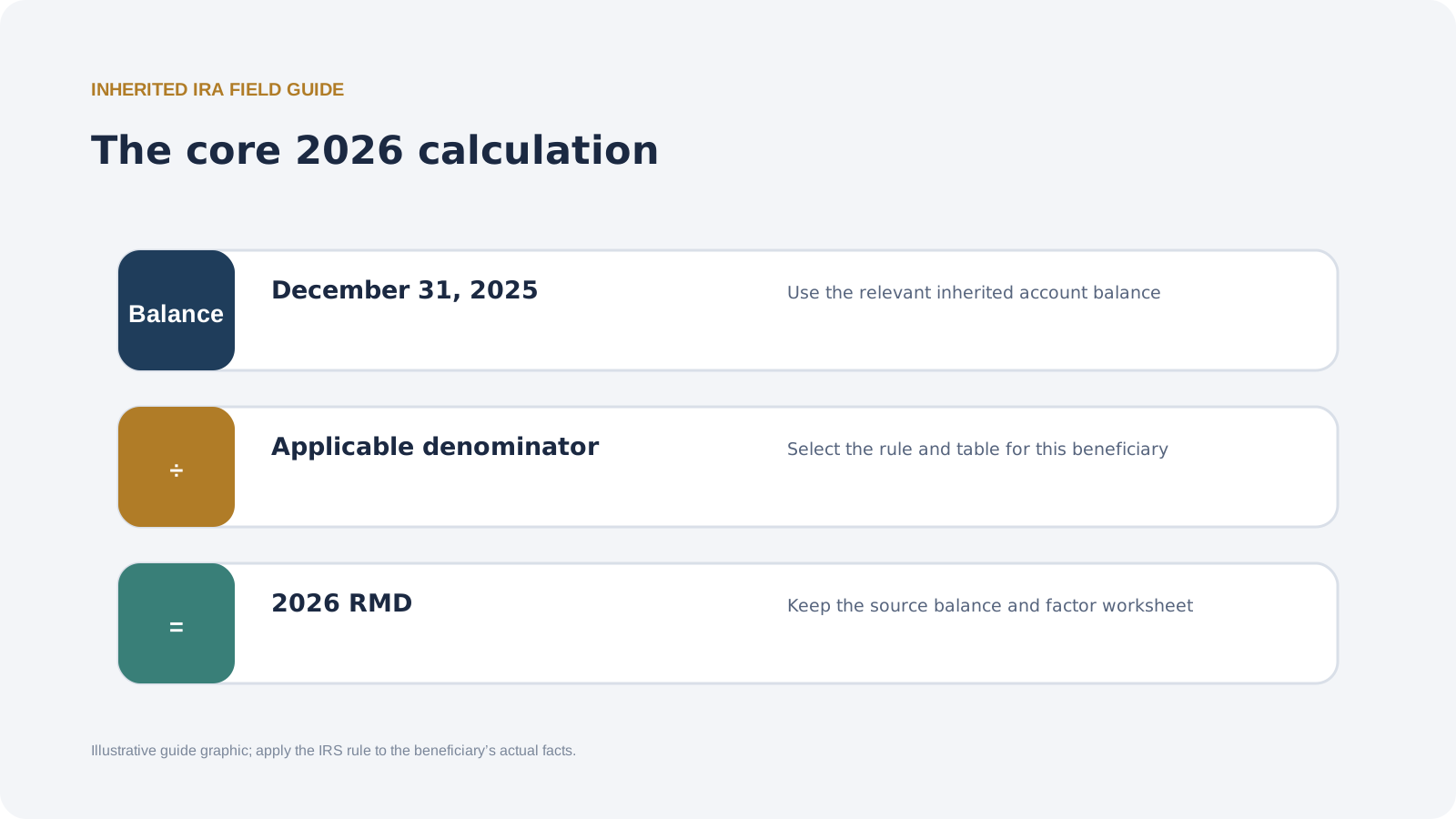
For an inherited IRA that has an annual required minimum distribution (RMD) in 2026, begin with the account value on December 31, 2025. Then divide by the applicable life-expectancy denominator under the beneficiary rules that fit the original owner and beneficiary. The math is short; identifying the correct rule is the hard part. A number from a custodian portal should be checked against the owner’s date of death, required beginning date, beneficiary status, and account history.
The IRS’s 2025 Publication 590-B includes 2026 examples and directs beneficiaries to use the prior year-end balance and the appropriate table denominator. These examples are educational calculations, not a substitute for a custodian’s records or tax advice. This guide focuses on traditional inherited IRAs and explains how to separate the owner’s final-year RMD from later beneficiary RMDs.
First identify which kind of beneficiary you are
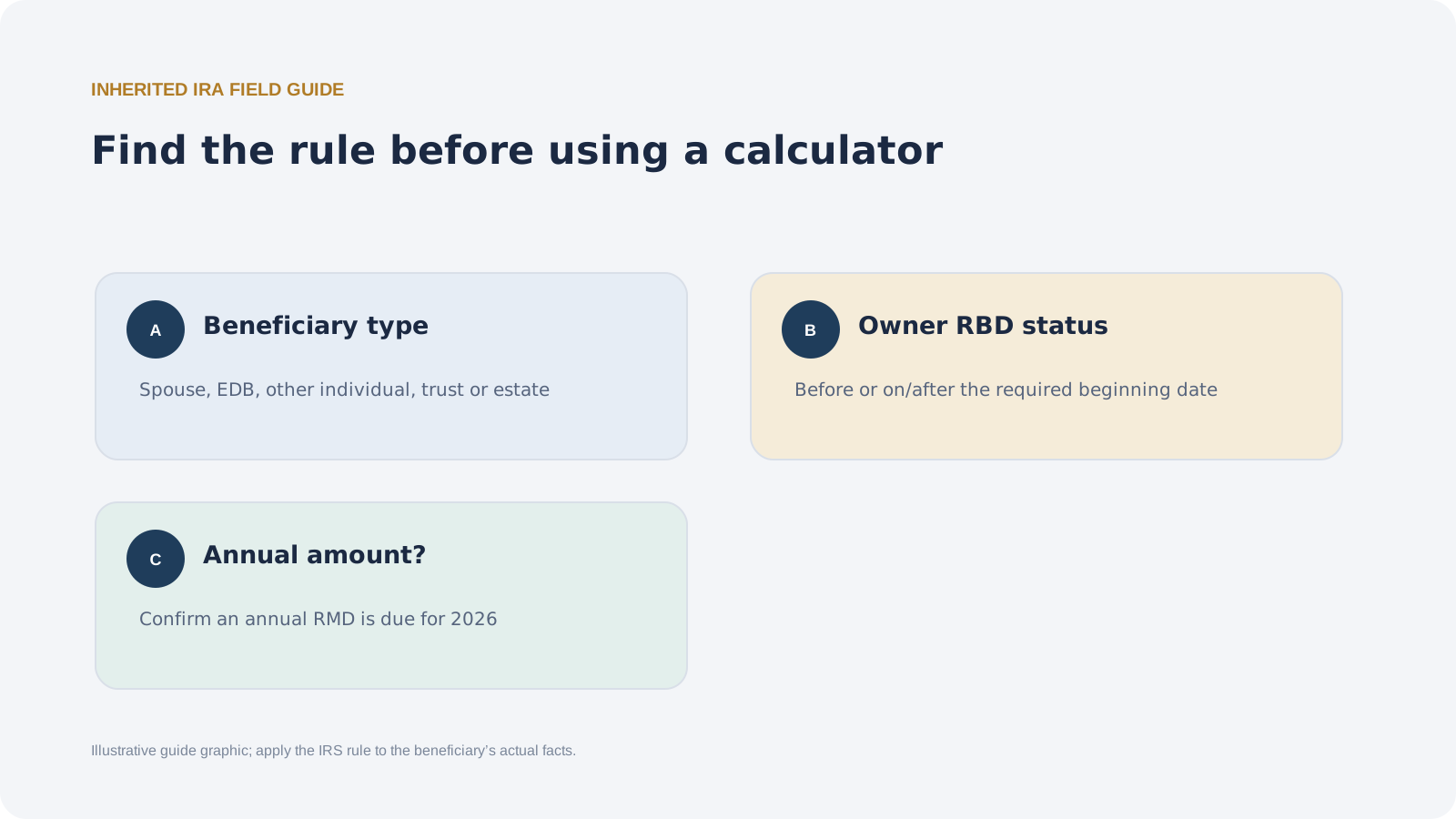
Do not start by dividing the balance by 10. An inherited IRA can involve an eligible designated beneficiary (EDB), an ordinary designated beneficiary, a surviving spouse choosing owner treatment, a trust, or an estate. The owner’s required beginning date (RBD) is also pivotal. A non-EDB beneficiary under the 10-year rule generally has no annual RMD in years one through nine when the owner died before the RBD, but must distribute the full balance by the outside deadline. When the owner died on or after the RBD, annual beneficiary RMDs generally continue in addition to the 10-year deadline.
An EDB may use a life-expectancy method, subject to the rules for that beneficiary category and any applicable 10-year outer limit. A surviving spouse has additional choices, including in some circumstances electing to treat the account as their own. Trust and estate outcomes depend on the beneficiary and trust rules; they should not be forced into a simple individual-beneficiary example.
The federal RMD regulations finalized in 2024 apply for determining RMDs for calendar years beginning on or after January 1, 2025. Older summaries written during the transition period may not describe the current annual-payment requirement. Confirm the correct branch under the current IRS publication and the custodian’s governing documents.
Use this 2026 calculation sequence
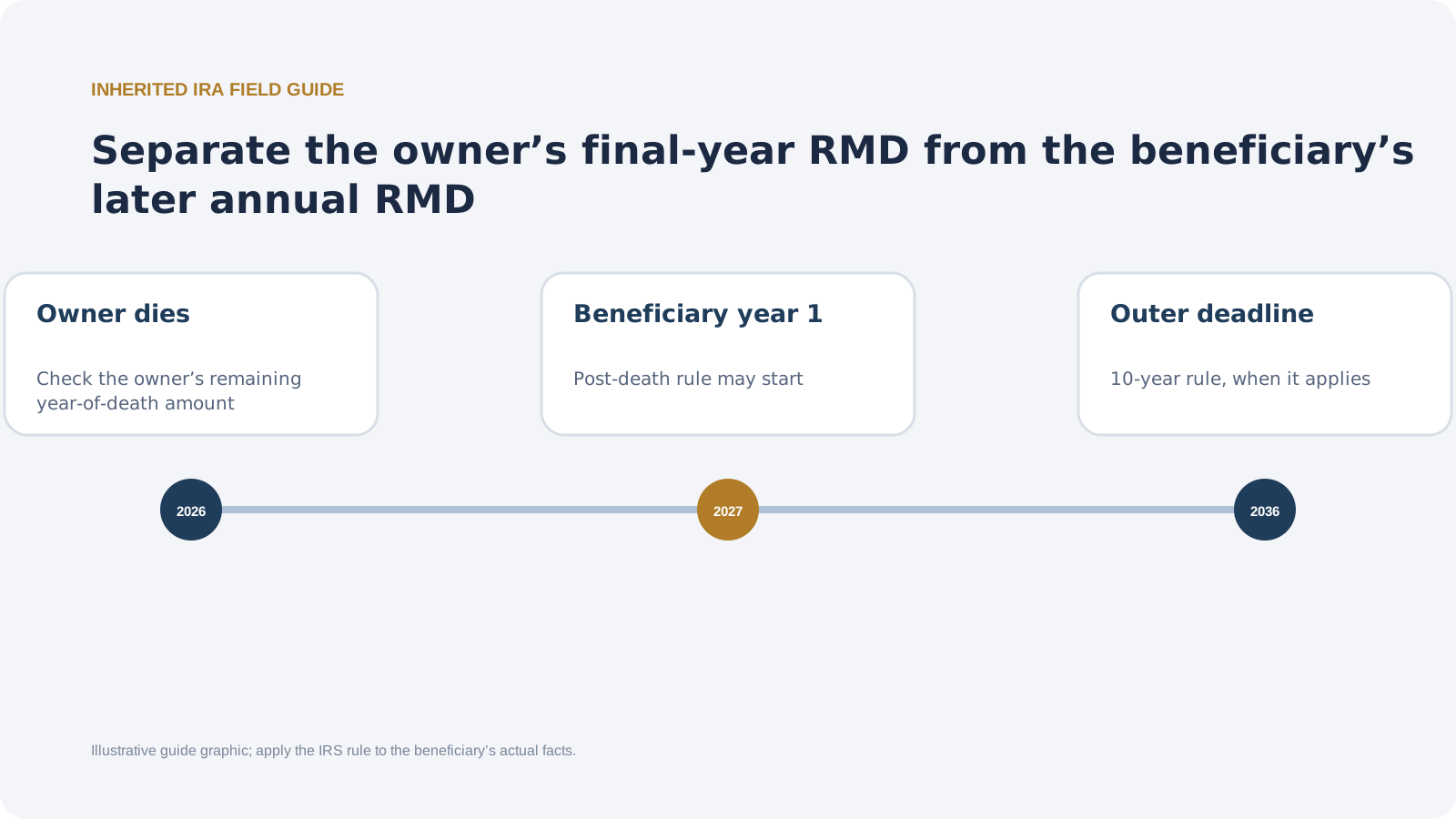
- Separate the year of death from 2026. If the IRA owner died in 2026, the owner’s own 2026 RMD is a separate calculation. If the owner died in an earlier year, the beneficiary’s 2026 RMD follows the post-death rules.
- Confirm that an annual 2026 distribution is required. Check EDB treatment, owner RBD status, the 10-year rule, spouse elections, and whether the beneficiary is an individual.
- Get the right balance. For a beneficiary life-expectancy RMD, use the relevant inherited IRA balance at the end of 2025, subject to the specific rule and any account-specific adjustment.
- Find the applicable denominator. The correct table and the year in which the initial life expectancy was established depend on the beneficiary path. Some post-RBD cases require comparing the beneficiary’s and owner’s remaining life expectancies and using the longer applicable denominator.
- Divide and keep the worksheet. Divide the applicable balance by the controlling denominator. Save the source table, age, year, owner comparison if needed, prior-year balance, and any distributions.
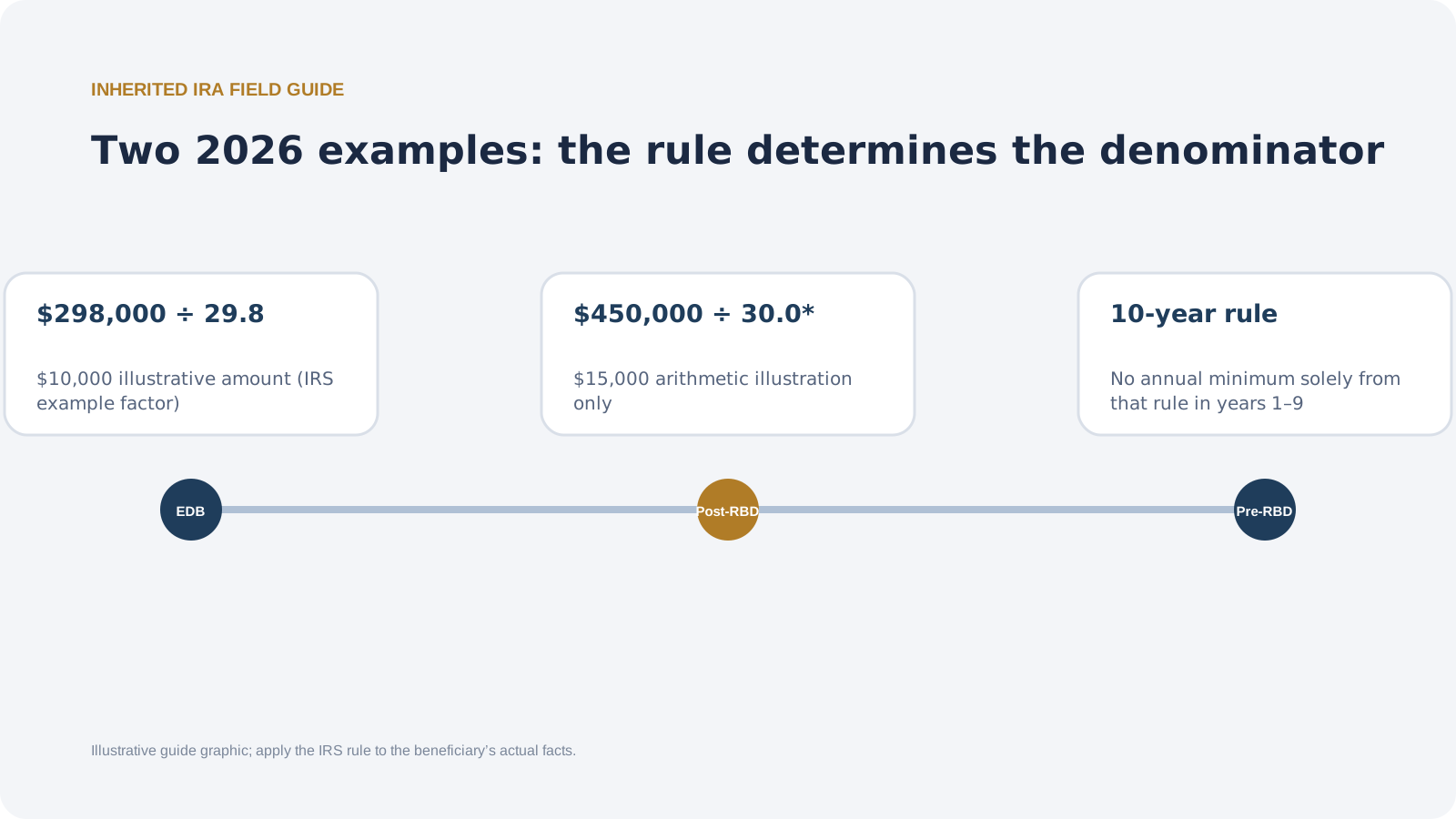
For example, IRS Publication 590-B says an eligible designated beneficiary who turns 57 in 2026 uses a Table I denominator of 29.8 in the example shown. If that beneficiary’s relevant December 31, 2025 balance were $298,000, the illustrative minimum would be $298,000 ÷ 29.8 = $10,000. The hypothetical balance is chosen only to show the arithmetic; it is not the IRS example’s account value.
How the 2026 branches differ
EDB using life expectancy. A non-spouse EDB generally starts annual payments in the year after the owner’s death and reduces the initial life-expectancy denominator by one each later year. Use the applicable IRS table and the beneficiary’s age in the correct starting year. Do not look up a fresh denominator from the beneficiary’s current age every year if the rule calls for reducing the original one.
Ordinary designated beneficiary; owner died on or after the RBD. Annual payments generally apply while the 10-year period runs. The beneficiary’s Table I life expectancy and, where applicable, the owner’s remaining life expectancy are compared under the rules. The annual amount is not automatically one-tenth of the account. The full remaining interest still must be distributed by the end of the tenth calendar year after the owner’s death.
As a simplified arithmetic illustration, if the correctly established controlling denominator for a beneficiary’s 2026 calculation were 30.0 and the relevant prior-year-end balance were $450,000, the quotient would be $15,000. The assumed 30.0 is for arithmetic only; it is not a universal factor. The beneficiary must derive the denominator from the actual dates, ages, and applicable table.
Ordinary designated beneficiary; owner died before the RBD. If the 10-year rule applies, there is generally no annual minimum required solely because of the 10-year rule before year 10. That does not erase the final distribution deadline. A plan document or another applicable beneficiary rule may change the result, so verify which branch applies.
Surviving spouse. A spouse may remain a beneficiary or elect owner treatment in circumstances allowed by the rules. The RMD year, denominator, and start date can differ. A spouse should not reuse a non-spouse example without first confirming the election and account registration.
Keep the owner’s year-of-death amount separate
If an owner died in 2026 on or after their RBD without taking the full 2026 RMD, the beneficiary is generally responsible for distributing the unpaid remainder of that owner-year amount. IRS Publication 590-B says to calculate that year as if the owner lived for the entire year. This is distinct from a beneficiary’s own post-death 2027 RMD, which uses its own applicable rule and balance. Keep the two calculations and tax-year records separate.
If the owner died before the RBD, there is no owner RMD for that year under the general IRA rule described in Publication 590-B. Other obligations can still arise in later years for the beneficiary. Confirm what the owner actually withdrew before death by obtaining the statement and distribution history, rather than relying on a year-end form alone.
Accounts that can be combined—and those that cannot
A beneficiary can generally aggregate RMDs across inherited traditional IRAs received from the same decedent, subject to the regulations and account facts. The same-decedent limit matters: an inherited account from a different person is not part of that pool. Inherited Roth IRAs have their own same-decedent aggregation rule. A qualified retirement plan such as a 401(k) is not simply added to an IRA aggregation calculation; plan distributions generally must be taken from that plan.
Separate beneficiary shares, trust arrangements, and transfers can create additional rules. Tell each institution about the other accounts and ask for the calculation basis in writing. A trustee-to-trustee transfer does not make historical age or denominator records irrelevant.
Deadline, tax reporting, and common calculation errors
For a typical annual beneficiary RMD, the distribution is generally due by December 31 of the distribution year. That makes December 31, 2026 the ordinary deadline for a 2026 annual RMD. The 10-year final deadline is a separate requirement and can require more than the annual minimum. An institution may also have earlier processing cutoffs, especially for complex beneficiary paperwork or year-end trades.
Traditional IRA distributions are generally taxable in the year received. The amount that satisfies an RMD and the amount included in taxable income are related but not interchangeable questions: basis, withholding, rollover treatment for an eligible spouse, and other facts may matter. A Form 1099-R usually reports distributions after the calendar year closes; it does not itself prove the correct RMD denominator was used.
- Using the December 31, 2026 balance for a 2026 calculation instead of the relevant prior-year-end value.
- Dividing by 10 without checking whether an annual RMD is also required.
- Looking up the beneficiary’s new table age every year when the applicable rule uses a starting denominator reduced by one.
- Ignoring the owner’s remaining life expectancy in a post-RBD comparison.
- Combining accounts inherited from different decedents or mixing an IRA with a 401(k).
- Assuming a larger withdrawal in 2025 can satisfy the separate 2026 minimum.
A practical record file for the 2026 RMD
Keep the owner’s death certificate, the beneficiary designation, the inherited-account registration, and a record of whether the owner had reached the RBD. Save the December 31, 2025 statement, the applicable IRS table page, the denominator history, the custodian’s written calculation, and the dates and amounts of withdrawals. If multiple inherited IRAs are being aggregated, label each by original decedent and account type. If the account is subject to a 10-year period, write down the final year and calendar deadline separately from the 2026 amount.
These records make it easier to identify a data mismatch before year-end and to reconstruct a calculation after a custodian transfer. If the owner’s RBD, beneficiary status, trust language, prior denominator, or date of death is uncertain, ask a tax professional to review those facts before submitting a distribution instruction.
Questions beneficiaries ask about 2026 inherited IRA RMDs
What balance do I use for a 2026 inherited IRA RMD? For a beneficiary calculation based on a prior-year-end account value, begin with the relevant December 31, 2025 balance and apply the denominator required by the beneficiary rule.
Does every inherited IRA need a 2026 withdrawal? No. The answer depends on beneficiary type, owner RBD status, the applicable 5- or 10-year rule, and any spouse election. Some ordinary beneficiaries under the 10-year rule may have no annual RMD in years one through nine if the owner died before the RBD.
Does a 2026 RMD finish the 10-year obligation? Usually not by itself. If the 10-year rule applies, the account still has to be fully distributed by the applicable final-year deadline.
Can I use a 2025 extra withdrawal for my 2026 minimum? Generally no. An amount above the minimum for one year does not ordinarily carry forward to satisfy the next year’s minimum.
This guide is general educational information. It is not individualized tax, investment, or legal advice.